Monday, February 12, 2007

Putin welcomes Opec-style gas group

Putin pledged to develop ties with the Islamic world during his first visit to Riyadh [AFP]

posted by aljazeera.net


Vladimir Putin, the Russian president, has welcomed the idea of creating a gas version of the oil cartel Opec on his arrival in the gas-rich emirate of Qatar.

Putin said: "Who said that we rejected the idea of creating a gas cartel? We haven't rejected anything. I said it was an interesting proposition."
bodyVariable350="Htmlphcontrol1_lblError";
At a press conference with Qatar's emir Hamad bin Khalifa al-Thani, Putin said: "Are we going to create this cartel, do we need it? That's another discussion."

Al-Thani said he supported the discussions but was unsure whether a gas cartel would be able to command the same market control as Opec.
bodyVariable300="Htmlphcontrol2_lblError";
Putin said: "It is important for us to understand each other, to co-operate, to work on common approaches for the creation of unified conditions for consumers."

He also thanked Saudi Arabia for helping to broker the Mecca agreement between Palestinian factions Hamas and Fatah.

The Russian president arrived from Riyadh where he offered to help Saudi Arabia develop atomic energy and pledged to develop ties with the Islamic world on the first leg of a regional tour to boost military and energy ties with traditional US allies.

Gas conference

Putin said he would send a team of experts to a natural gas conference being held in Doha in April, where they would discuss details of building a cartel resembling the Organization of Petroleum Exporting Countries.

Qatar is an Opec member but Russia is not.

The emirate, which has the world's third largest gas reserves after Russia and Iran, is home to a pair of large US military bases, one of which houses the US command post for operations in Iraq and Afghanistan.

In January, Iran - which is developing its gas industry - said it was in favour of forming a cartel. The country's supreme leader Ayatollah Ali Khamenei proposed Iran and Russia create a gas cartel in talks with the head of Russia's security council, Igor Ivanov.


Thursday, February 08, 2007

Olmert 'rejects ending al-Aqsa dig'

Olmert gave the go-ahead for dig work to continue despite an appeal from his defence minister [EPA]
posted by aljazeera.net
Israel's prime minister is reported to have rejected a call from his defence minister to halt excavation work near Jerusalem's most important holy site, an Israeli newspaper reports.

Ehud Olmert, the Israeli leader, said he would allow the dig near the al-Aqsa mosque compound in Jerusalem to continue after the appeal from Amir Peretz.
bodyVariable350="Htmlphcontrol1_lblError";
"A thorough examination of the matter would reveal that nothing about the work under way will harm anyone, and there is no truth in the contentions against the work," the Ha'aretz newspaper quoted Olmert's office as saying.

Arab states have said the work could damage al-Aqsa's foundations.
bodyVariable300="Htmlphcontrol2_lblError";
For years the Islamic Movement has waged a campaign to "save" al-Aqsa, the main mosque in a compound in Israeli-occupied and annexed east Jerusalem.

The compound is known to Muslims as Haram al-Sharif and to Jews as the Temple Mount.

The mosque is the third holiest site in Islam.

The Israeli defence ministry did not immediately comment on Thursday's report and Olmert's office was not available for a response.

On alert

Israeli police remained on heightened alert on Thursday, with about 2,000 officers deployed throughout the Old City and nearby areas in east Jerusalem.

About 100 Palestinians briefly blocked an entrance to Jerusalem's Old City in response to the excavations.

Micky Rosenfeld, an Israeli police spokesman, said the protesters dispersed peacefully after police ordered them to do so.

Tensions have flared between Israel and the Palestinians over the Israeli excavation, which started on Tuesday.

Haaretz said Peretz wrote to Olmert on Wednesday calling for the immediate stop to the work, citing security concerns.

Palestinian warning

The Fatah faction of Mahmoud Abbas, the Palestinian president, said any damage caused to the mosque by the dig work would "lead to a termination" of a November ceasefire deal operating in Gaza, and spark a "volcano of anger".

"I turn to Olmert to think anew," Sheikh Abdallah Nimr Darwish, head of Israel's Islamic Movement, told Israel Radio.

"Whoever wants to speak about peace does not excavate anywhere in the area around the holy al-Aqsa mosque," Darwish said, referring to Olmert's planned February 19 peace talks with Abbas and Condoleezza Rice, the US secretary of state.

Israel say the excavations are part of a search for ancient artefacts beneath the compound but would not harm the sacred site in Jerusalem's walled Old City.

Webcast proposal

The Israel Antiquities Authority is carrying out initial excavations before repairing an access ramp.

Osnat Gouez, an authority spokesman, said: "We are looking at the possibility of installing cameras at the start of next week that would broadcast real-time footage on the internet of the excavations being carried out at the site."

A parliamentary spokesman said Israel Hasson, an Israeli MP, made the suggestion on Wednesday to Olmert who ordered that the idea be put into practice.

Hasson said: "This initiative is to prove to the Arab world that the works under way on site pose no harm to the mosques."

Monday, February 05, 2007

Senate vote blocks Iraq plan debate

Bush plans to send 21,500 more US troops to Iraq [EPA]
By Aljazeera.net

Republicans have blocked a debate on the Iraq war in the US Senate, dealing a setback to critics of George Bush's plan to send 21,500 more troops to Iraq.

Republicans largely united to employ Senate rules against the Democrat majority to derail the debate on a nonbinding resolution expressing disagreement with Bush's plan.
bodyVariable350="Htmlphcontrol1_lblError";
But Democrats vowed that they would not give up trying to force Bush to change course and said they would return to the subject when considering billions more in funding for the Iraq war requested by Bush on Monday.

Harry Reid, the Senate Democrat leader, said: "We are going to debate Iraq.
bodyVariable300="Htmlphcontrol2_lblError";
"They may stop us temporarily from debating the escalation but they are not going to stop us from debating Iraq."

The resolution would not have been binding on Bush, but it was the first serious attempt by Congress to confront him over the war.

Under Senate rules it needed 60 votes before the 100-member Senate could begin debate. It received only 49, with 47 voting against in a largely party-line vote.

'Real debate'

Opponents said the measure, sponsored by Virginia Republican senator John Warner and Michigan Democrat senator Carl Levin, was a thinly disguised political slap at Bush that would dishearten US troops and signal American disunity.

Republicans also said they voted against the measure in protest because they could not get amendments considered on their terms.

Kentucky Republican Mitch McConnell, the Senate minority leader, said: "We are asking for a fair process. We are ready for the debate. We expected to have it this week."
Supporters said the resolution would be a first step, a warning to Bush that he must revamp his strategy to start moving toward a withdrawal of the 138,000 US troops in Iraq.

Dick Durbin, the Illinois Democratic senator, said: "I am troubled by this. If the Republicans in the Senate cannot swallow the thin soup of the Warner resolution how will they ever stomach a real debate on the war in Iraq?"

Some Democrats want Congress to move immediately to do something more decisive like refusing to fund the additional troops or capping troop levels.

Dana Perino, a White House spokeswoman, said: "All sides have a right to be heard in this debate, and we support senator McConnell's and the Republicans' right to be able to offer the amendments they want to offer."

Two Republicans refused to follow their party leadership and voted with the Democrats to move to debate. They were senator Susan Collins of Maine and senator Norm Coleman of Minnesota, both of whom face re-election in 2008.

Before the vote, Reid said: "The American people do not support escalation. Last November, voters made it clear they want a change of course, not more of the same.

"The president must hear from Congress, so he knows he stands in the wrong place, alone."

Durbin said: "If the Republicans want to stand by their president and his policy, they shouldn't run from this debate.

"If they believe we should send thousands of our young soldiers into the maws of this wretched civil war, they should at least have the courage to stand and defend their position."

Friday, February 02, 2007

Naji Al-Ali (1936 - 1987)

Naji Al-Ali (1936 - 1987)

Naji Al-Ali lived on the edge of danger because he was closest to the truth. He was the last scream that we never dared utter for fear to be quenched with it.
The Palestinian cartoonist par excellence, Naji Al-Ali is an artist who transcended fictional frontiers using lines that draw free borders, the boundaries of freedom without pavements, the freedom of the artist, the people, and the homeland.
Every morning, for more than 13 years (1975 - 1987) Palestinians everywhere followed the cartoonist Naji Al-Ali in whichever newspaper he published. His cartoons were re-printed in more than one form, and discussed in every forum. He made everyone read the newspaper starting from the back page. Everyone who worked with him said that he was wild, that the burning fire within him devoured everything, because his heart was in his quill and his quill was easily agitated and inflamed. He felt that Palestine was his own, and it will not return piece-meal, but all at once, all at once from the river to the sea, or else, no one will forgive. The bitterness within him was constantly expanding, and he eventually thrashed at everyone with his ruthless quill.
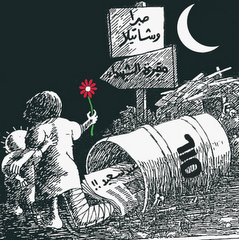
His character was "Handala", a young boy with curly hair whose back is always turned to the reader. His name means "bitterness" in Arabic, and he represents the distress the artist felt. In describing his work, Naji Al-Ali wrote:


"The child Handala is my signature, everyone asks me about him wherever I go. I gave birth to this child in the Gulf and I presented him to the people. His name is Handala and he has promised the people that he will remain true to himself. I drew him as a child who is not beautiful, his hair is like the hair of a hedgehog who uses his thorns as a weapon. Handala is not a fat, happy, relaxed, or pampered child, he is barefooted like the refugee camp children, and he is an 'icon' that protects me from making mistakes. Even though he is rough, he smells of Amber. His hands are clasped behind his back as a sign of rejection at a time when solutions are presented to us the American way. Handala was born ten years old, and he will always be ten years old. At that age I left my homeland, and when he returns, Handala will still be ten, and then he will start growing up. The laws of nature do not apply to him. He is unique. Things will become normal again when the homeland returns. I presented him to the poor and named him Handala as a symbol of bitterness. At first he was a Palestinian child, but his consciousness developed to have a national and then a global and human horizon. He is a simple yet tough child, and this is why people adopted him and felt that he represents their consciousness."


"What is the role of political caricature?""Its role is to bare life... caricature always hangs life to dry in the open air and in the public streets... it grabs life wherever it finds it to place it on the rooftops of the world where there is no place to fill the gaps or cover its holes.""When will people see Handala's face?""When Arab dignity is no longer threatened, and when the Arab individual regains his freedom and humanity. Still, the most tiring part is to continue the road with all its contradictions. The weariness of the homeland will always remain deep inside.""Handala is the witness of the century who will never die... the witness who entered life all of a sudden and will never leave it. He is the legend-witness. This character was born to survive... I will continue within him even after I die."
Naji Al-Ali was born in Ash-Shajara village in 1936, one of 480 villages destroyed after 1948. His family was displaced to Ein Al-Hilweh refugee camp in Lebanon. Between 1957 and 1983 he worked for a variety of newspapers in Lebanon and the Gulf. In 1983 he returned to Kuwait to work for "Al-Qabas" newspaper until 1985 when he was forced to leave to London to work with the same newspaper in its London office. During this period he published more than 40,000 cartoons. The New York Times once wrote: "If you want to know what the Arabs think of the US look at Naji Al-Ali's cartoons." The Time magazine also described him saying: "This man draws with human bones." The 'Asahi' Japanese newspaper wrote: "Naji Al-Ali draws using phosphoric acid."


On Wednesday July 22 1987 at 17:10 Greenwich meantime, Naji Al-Ali parked his car in central London, and walked a few meters towards the offices of Al-Qabas newspaper where he worked. A dark complexioned, curly haired, young man surprised him with a bulletin his head and ran away as Naji Al-Ali fell on the pavement. On August 29th, Naji Al-Ali finally died in hospital and was buried on September 3rd in Brookwood cemetery in Woking. His death marked the end of an era, and ironically, the beginning of the Intifada in the West Bank and the Gaza Strip. Until this day, his cartoons are used over and over again, and "Handala" is still as relevant today as he was twenty years ago.


From "This week in Palestine" No 14, August 1999

Posted by Martin BretterklieberUpdate: 26. Mai 2001.

Environment minister taking climate-change report "very seriously"

Pollution and haze in Bangkok seen from a an aerial view during rush hour on February 2, 2007 in Bangkok, Thailand. A report by the Intergovernmental Panel on Climate Change (IPCC) has stated that climate changes are "very likely" to have human cause and that global temperatures will rise by 3 degrees Celsius by 2100.
Photograph by : Getty Images


OTTAWA — The Conservative government says the scientific community’s "unequivocal" warning about climate change in a new report released in Paris on Friday is a turning point in history that it is taking "very seriously."
"I think the science is clear that these changes are occurring … and we must act," said Prime Minister Stephen Harper at an Ottawa news conference. "We are working through the Kyoto process to try and get international action to try and get action that will involve all of the world’s major emitters, and as you know, currently, most of the major emitters are not part of the protocol, or at least have no targets under the protocol. So these are efforts that are important that we will continue to work on."
The comments contrasted with statements Harper made as opposition leader in recent years when he questioned the scientific evidence, and described Kyoto as a "socialist scheme" to drain money from developed nations.
But Environment Minister John Baird said the government understands the message from the report, which was produced by the Intergovernmental Panel on Climate Change.
"We recognize that the report is an important scientific study on climate change and we take its findings very seriously," Baird said at a news conference in Paris after being briefed by experts from Environment Canada and other international officials.
Hundreds of climate scientists delivered their findings on Friday morning after reviewing the work of more than 2,000 researchers — including skeptics.
They predicted global temperatures will rise faster in the 21st century than in the previous 100 years, with stronger increases for countries in northern regions such as Canada. They also concluded some aspects of global warming would continue for centuries, regardless of any mitigation efforts.
"Warming of the climate system is unequivocal, as is now evident from observations of increases in global average air and ocean temperatures, widespread melting of snow and ice, and rising mean sea level," reads the summary report released by the Intergovernmental Panel on Climate Change, a peer-review panel representing scientists from nations around the world.
The report is the first volume of its fourth assessment of the latest scientific literature since the 1990s, and its strongest ever warning that human activity is responsible for global warming.
Baird promised his government would soon introduce regulations and targets for industry, but he refused to commit to meeting Canada’s legally binding targets to reduce greenhouse gas pollution as required under the international Kyoto Protocol. He said the government wanted to focus on what it could do, instead of what was not possible to achieve.
"The fourth report of the Intergovernmental Panel on Climate Change will constitute a turning point in the battle against climate change for the world," he said. "Therefore we must accept what the experts say. We must devote our energy to find solutions that would protect the fragile ecosystems of our planet, and we must adopt concrete measures to fight against climate change. And when I say ‘we,’ I mean Canada and all countries. Climate change is a global issue that requires a planetary solution."
Although the scientists concluded there was a 66 per cent probability humans were responsible for global warming in the last IPCC report from 2001, they now say the latest research tells them there is a 90 per cent probability that human activity, mainly through the burning of fossil fuels, are producing the greenhouse gases that cause the climate to change.
"The global concentrations of carbon dioxide, methane and nitrous oxide, all greenhouse gases those are, have increased markedly since 1750, and they are now far, far above the values seen in ice cores in many, many thousands of years," said Susan Solomon, a U.S. climate scientist and lead author of the study, at a news conference. "The increases in carbon dioxide are mainly due to fossil fuel use and land-use, while those of methane and nitrous oxide are due to agriculture.
The findings come as Harper’s government faces widespread criticism from environmentalists and opposition parties for turning his back on Canada's international commitments to reduce greenhouse gases by slashing billions of dollars in climate change initiatives.
Under the Kyoto Protocol, the former Liberal government committed Canada to reduce greenhouse gas emissions by six per cent below 1990 levels, although when they left office, the country was about 35 per cent above its target.
The report predicted a 0.2 C average global temperature increase per decade over the next 20 years, and a 0.1 C increase for subsequent decades. An increase in hotter days and a decrease in colder days is virtually certain, according to the report. It also concludes there would be an increased probability of more frequent droughts in some regions, and heavy precipitation or extreme weather events in others.
But the scientists refrained from lecturing world leaders to take action.
"I believe that is a societal choice," said Solomon. "I believe science is one input to that choice, and I also believe science can best serve society by refraining from going beyond its expertise, so I do not feel that it would be in the best interest of society making this decision in the most responsible way for me to push for urgency or action. There are people out there who have that role. But it isn’t me, and in my view, that’s what IPCC also is all about: Namely not trying to make policy prescriptive statements, but
Posted by CanWest News Service
Published by
Mike De Souza, CanWest News ServicePublished: Friday, February 02, 2007

Sunday, January 28, 2007

French socialists expel racist

The expulsion comes at a bad time for Royal as she faces criticism for a series of gaffes [AFP]

The French Socialist party has expelled one of its leading members for having said there were too many black players in the national football team.

Georges Freche, president of the Languedoc-Roussillon region in the south and a founding member of the party, is a supporter of the Socialists' presidential candidate, Segolene Royal.
bodyVariable350="Htmlphcontrol1_lblError";
She has backed his expulsion from the party but it comes at a bad time for her as she faces criticism for a series of gaffes.

On Friday, an imitator known for phone pranks on public figures tricked Royal into thinking she was talking to the premier of Quebec.
bodyVariable300="Htmlphcontrol2_lblError";
The decision on Saturday was made at a meeting of members of a commission set up to resolve internal party disputes.

Patrick Mennucci, deputy director of Royal's campaign, said: "If he had not said what he said, we would all ... be in a much more agreeable situation."

"The situation is very unpleasant and the Socialist Party cannot continue to have someone who makes comments of this sort in its ranks."

'Sub-human'

In November, Freches was reported complaining at a local political meeting that nine out of the 11 members of the national soccer team were black.

"I am ashamed for this country. Soon there will be 11 blacks," the Midi Libre newspaper quoted him as saying.

Freches was also fined 15,000 euros by a French court on Thursday for having called Algerians who fought alongside the French in Algeria's war of independence "sub-human".

He had already been suspended from some party functions after making those comments last year and faced up to six months in jail for "abuse of a group of people because of their ethnic, racial or religious affiliations".

posted by aljazeera.net
Translated by NewsClock.com to Chinese


驱逐坏的时候,正值她面对批评皇家一系列气得[法新社]

法国社会党及其领导成员之一,已经开除因说黑人球员有太多的国家队. 乔治freche总统的郎-南区Roussillon创始党 社会党的支持者是『总统候选人,segolene皇室. bodyvariable350="htmlphcontrol1_lblerror"; 她背靠他开除党籍,但不好的时候,正值她的批评,因为她脸上的一系列气得. / 在周五、 一个电话恶作剧模仿闻名于公众人物的思想变成皇家上当她所说的魁北克总理. bodyvariable300="htmlphcontrol2_lblerror"; <决定>是在周六举行成立一个委员会的成员来解决党内纷争. 帕特里克mennucci副主任王国的战役,说:"如果他没有说什么,他说: ::我们都可以在一个更合意的情况. " "形势非常愉快和社会主义党不能继续作出评论,有人曾这样的队伍" '分人'11 freches报道抱怨当地政治会议的11个成员的九个国家足球队被黑. "我很惭愧,为这个国家. 很快会有11个黑人"午报该报引述他的话说. freches还被罚了1.5万欧元法国法院传唤周四为阿尔及利亚人并肩战斗的法国人在阿尔及利亚的独立战争"撒哈拉人". 他已被暂停职务后,一些党有心去年面对六个月徒刑"滥用一群人因种族、 种族或宗教背景".

Friday, January 26, 2007

Russia and West divided over Kosovo

A boy walks past graffiti in in Kosovo which reads: "No negotiation - Self-determination."

posted by Aljazera.net


Russia has reacted unfavourably to a United Nations plan to give Kosovo greater independence from Serbia.Martti Ahtisaari, the UN special envoy for Future Status Process for Kosovo, unveiled the plan at the UN complex in Vienna to the six-nation Contact Group on Friday. which
bodyVariable350="Htmlphcontrol1_lblError";
The Group, comprising the US, Russia, Britain, France, Germany and Italy, has set policy on Kosovo since the United Nations took control of the province in 1999.

After the meeting, Ahtisaari said Russia had called for any decision on Kosovo to be delayed until Serbia formed a new government.
bodyVariable300="Htmlphcontrol2_lblError";
The five other members of the group - the US, Britain, France, Italy, Germany - were in favour of the plan and saw no need for delay, he added.

Ahtisaari needs the approval of the Contact Group before he can make the plan public.Diplomatic sources had said that the Vienna meeting was intended to be the last step before Ahtisaari presented his blueprint to officials in Pristina and Belgrade on February 2.Serbs and Kosovo Albanians had been due to discuss the fine print of the deal during February, although there was little prospect of them reaching an agreement.Independence demandedEight years after Nato drove out Serb forces accused of ethnic cleansing in the province, Kosovo is demanding nothing less than full independence.
Meanwhile, Serbia is offering only far-reaching autonomy for a territory that it sees as the traditional birth-place of the Serb nation.Ahtisaari said on Wednesday that his plan would focus on "the protection of minority rights, in particular of the Kosovo Serbs" and "a strong international civilian and military presence within a broader future international engagement in Kosovo."Diplomatic and UN sources told Reuters news agency that Kosovo would be given the right to apply for membership of international organisations, potentially including the United Nations, the International Monetary Fund and the World Bank. They said it would provide for a right to dual citizenship, and urge Pristina to establish good relations with Serbia and other neighbours, but would contain no reference to Serbian sovereignty. Self-determinationGermany, Britain, France, Italy and the United States have all said they believe the Albanians should be granted self-determination but Russia has said it will not back a solution that goes against the wishes of Serbia, a fellow Slavic and Orthodox Christian nation that is a natural ally.Diplomats had said they felt there was enough room for manoeuvre between the two positions to avoid a Russian veto in the UN Security Council later this year.Nato countries, which have more than 16,000 peacekeepers in Kosovo, have vowed to maintain support for international efforts to resolve its status but called a rapid resolution. "There was an enduring and unflagging commitment for Nato to play its part in the process related to status and beyond it," James Appathurai, Nato spokesman, said."There was a strong sense around the table on the need for a resolution as soon as possible. Long delays risk a lack of clarity, risk fostering instability," he added.
posted by aljazeera.net

Thursday, January 25, 2007

Curfew follows fatal Beirut clashes

Posted By Aljazeera.net

A curfew has been declared in Beirut after four students were reported killed as rival groups of pro- and anti-government students fought a pitched battle at a university, leaving at least 35 others wounded.

The curfew, from 8.30pm (1830 GMT) until dawn on Friday, was declared by the Lebanese army following hours of violence in the capital.
bodyVariable350="Htmlphcontrol1_lblError";
Students wielding clubs and throwing rocks attacked each other at the Al-Arabiya University in a southern sector of the Lebanese capital. Al Jazeera correspondent Mike Hanna said the fighting "started with an argument and then got physical".
bodyVariable300="Htmlphcontrol2_lblError";
"It was a very intensive and very serious clash on the campus highlighting the political divisions across the country."


The fighting began on the main campus and then moved out on to the street, as students set fire to tyres and cars in order to block traffic. Dozens of men wearing construction helmets and carrying makeshift weapons - chair legs, pipes, garden tools, sticks and chains - converged on the university and fought with police.
University cordoned offTroops fired into the air to try and break up the crowds and cordoned off the neighbourhood. Military trucks were used to evacuate the streets of civilians trapped by the violence.


Some students claimed that during the fighting they came under fire from snipers on the surrounding rooftops.
Followers of the Future Movement led by Saad al-Hariri, the anti-Syrian parliamentary majority leader, and opposition supporters of the Shia Hezbollah movement and its ally Amal, were said to have been involved in the clashes.
Television stations run by both camps blamed each other for the violence. Fouad Siniora, the prime minister, appealed to the Lebanese to "avoid tension and escalation.""I call on everyone to return to the voice of reason," he added.
Call for calmHezbollah issued a statement urging its supporters to leave the streets around the university and respect the curfew."We are using a Fatwa (religious decree) ... in the interests of the country and civil peace ... everyone should evacuate the streets, remain calm and leave the stage for the Lebanese army and security forces," he said.


The Lebanese army fired shots into the air to disperse the students


Nabih Berri, the parliamentary speaker and leader of Amal, told several Lebanese television stations: "What everyone should do now is halt the strife.""I call upon you once again to channel all your powers towards reconciliation ... towards national unity," he said.Al-Hariri urged his followers to "remain calm and not respond to provocation".The fighting followed widespread unrest in the country earlier this week when the opposition staged a general strike and subsequent fighting left at least six people dead and scores injured.
The opposition is seeking veto power in government and early parliamentary elections to topple the Siniora's cabinet.
Siniora and al-Hariri have refused to accept the demands.
Al-Taamir clash
Another clash between troops and armed men, belonging to a group called the Jund al-Sham, in al-Taamir district near Ain al-Helwa camp in southern Lebanon left three people hurt, including a soldier.
Al Jazeera's correspondent reported that the fighting erupted after the armed men obstructed the troops' deployment in the area.
Soldiers opened fire after the armed men threw stones. Witnesses said three people were injured.
The violence came as Siniora won pledges of more than $7bn in aid at a donors' conference in Paris to help rebuild Lebanon following the war between Israel and Hezbollah last summer.


Posted By Aljazeera.net

Wednesday, January 24, 2007

Olmert urges president to go

Katsav said he had already faced a "trial by media
posted by aljazeera.net

Ehud Olmert, the Israeli prime minister, has called for Moshe Katsav, the Israeli president, to resign over allegations of rape and sexual assault.

On Wednesday, immediately after Katsav publicly refuted the allegations against him and promised to clear his name, Olmert said he had "no doubt" that Katsav should stand down.
bodyVariable350="Htmlphcontrol1_lblError";
Olmert said: "I have no doubt that the president cannot continue and fulfill his position and he should leave the residence of the president of Israel."
bodyVariable300="Htmlphcontrol2_lblError";
In a statement on Tuesday, Menachem Mazuz, the attorney general, announced he planned to indict Katsav on suspicion that he raped a former staff member and sexually assaulted three other women who worked for him.

Katsav called the allegations "smears and lies" that were "terrible, hurtful" and said: "I will fight to my last breath to clear my name."

He said he had already suffered a "trial by media".

Appeal to the citizens

Analysts saw Katsav's speech as an attack on the media and an appeal to public opinion.

He appealed directly to the citizens of Israel, saying: "As time goes by and as the facts emerge you, the citizens of Israel, will understand what terrible injustice has been done here."

Gill Hoffman, a journalist with the Jerusalem Post, told Al Jazeera: "He [Katsav] was really talking to the media and the Israeli citizens rather than members of the knesset [Israeli parliament]. A lot of Israelis will sympathise with him - they will now question what they thought before."
Jacky Rowland, Al Jazeera's correspondent in Israel, said: "He was trying to appeal over the heads of the opinion makers.

"The bottom line is that the fact that any allegations have been made against him casts a stain over the presidency.

"And people feel the president, in the interests of the dignity of the office that he holds, should step down."

Earlier in the day Katsav notified the knesset that he was taking a leave of absence from his duties.

Dalia Itzik, the knesset speaker, will temporarily fill the position - the first time the country has had a female president.

Under Israeli law, the president cannot be put on trial while in office but the knesset does have the power to impeach him.

But analysts say an investigation could take over a year and Katsav's presidency is due to end in July.

Mazuz said he would invite Katsav and his lawyers to a hearing, the date of which has not been set, before finalising charges.

Katsav has said he will resign if he is charged.


Corruption
Nour Odeh, Al Jazeera's correspondent in Gaza, said that Palestinians, who are also experiencing internal political conflict, "know that when there is internal trouble in Israel, it is Palestinians who end up paying the price".

She also said the events were "a further indication to Palestinians not to put their faith in Israeli politicians".

The post of president in Israel is largely ceremonial and the case is unlikely to have any direct impact on the government or on Olmert, who himself is under investigation over alleged corruption.

The knesset elected Katsav as president in 2000, after Ezer Weizman, the previous president, resigned from the post following revelations he had received $450,000 in gifts from a French millionaire.

Posted By Aljazeera.net

Tuesday, January 23, 2007

Bush warns against failure in Iraq

For the first time in his presidency Bush addressed a Democrat-controlled congress [Reuters]

George Bush, the US president, has used his seventh annual State of the Union address to urge Congress to give his Iraq plan "a chance to work".

He warned against "failure" in Iraq and described the war there as part of a larger battle against Sunni and Shia extremists who were "faces of the same totalitarian threat".
bodyVariable350="Htmlphcontrol1_lblError";
"Many in this chamber understand that America must not fail in Iraq - because you understand that the consequences in failure would be grievous and far reaching," Bush said.

He also addressed domestic issues, proposing fuel usage cuts to curb climate change and health care and education reforms.
bodyVariable300="Htmlphcontrol2_lblError";
"Totalitarian threat"

He said the Iraq war had changed dramatically with the outbreak of sectarian warfare and reprisals.

"This is not the fight we entered in Iraq, but it is the fight we are in," he said.

"It is still within our power to shape the outcome of this battle," the president said. "So let us find our resolve and turn events toward victory."
He said Shia extremists backed by Iran and Sunni extremists aided by al-Qaeda and the "old regime" would take over in Baghdad if America "failed" in Iraq.
He said the most important mission in America's history was to "spare the American people from this danger" and asked for support for his plan to send an extra 21,500 US troops to Iraq.
A Washington-Post/ABC News poll released on Monday gave Bush a job approval rating of 33 per cent, showing him to be at the weakest point of his presidency.
In his address to a nation increasingly opposed to the Iraq war and to a congress which for the first time in his presidency is controlled by Democrats, Bush stressed the need for unity.

Domestic policy

Bush also used the address to outline a domestic policy for the year.

"A future of hope and opportunity begins with a growing economy - and that is what we have. Unemployment is low, inflation is low, and wages are rising," he said, adding that more enterprise rather than increased government intervention was key.

He also called for Republicans and Democrats to overcome differences concerning the direction of social security spending.

He proposed a reduction in US fuel usage by 20 per cent in 10 years, an increase in health care for Americans, a new immigration policy and improvements to education.
Bush said that improved vehicle fuel standards and diversification of energy sources – such as the use of ethanol fuel – was necessary.
"It is in our vital interest to diversify America's energy supply and the way forward is through technology," he said.

The energy proposals by Bush fall short of seeking mandatory caps on carbon emissions which are sought by some Democrats in the congress.

Bush is not pushing for a specific increase in the Corporate Average Fuel Economy (CAFE) standards, which many experts see as critical to reduce oil usage but which the White House fears would prompt manufacturers to build smaller, less-safe cars.
Instead, he will ask congress for authority to reform CAFE standards, with the goal of reducing projected annual fuel use by up to 8.5 billion gallons, according to Joel Kaplan, the deputy White House chief of staff.

Strategic reserve

Bush also called for doubling the strategic petroleum reserve from 727 million barrels to 1.5 billion barrels, in a bid to bolster US energy security.
The US will begin buying extra oil this spring as part of a plan by the Bush administration to expand emergency reserves, the White House said on Tuesday.

"Expanding the strategic petroleum reserve is a wise and a prudent policy decision that would provide an additional layer of protection for our nation's energy security," said Sam Bodman, the US energy secretary.

Meanwhile, Bush's health care plan will propose making health insurance taxable income and deductible up to $15,000 a year for families, starting in 2009.

The move could raise taxes for as many as 30 million Americans but lower costs for many others.
A US official said the plan would cost $30 to $40 billion in its formative years but eventually pay for itself.
posted by aljazeera.net

Monday, January 22, 2007

The Iraqi Sniper - القناص العراقي


Baghdad -
لم يكد الجندي الأمريكي ايفرسون يخرج من دبابتة، - قرب مدخل مخفر أمريكي يسمى السيف في الانبار- حتى التقطه قناص عراقي برصاصة 7.62 ملليمتر فأصابته إصابة مباشرة فوق الجزء الأعلى من صدريّتة الواقية، فمزقت كتفه وخرجت من ظهره.No sooner had the American soldier Iverson out from the tank, near the entrance station-called American sword in Anbar - even plucked an Iraqi sniper bullet 7.62 millimeters injuring him directly over the upper part of the protective Sadrith, fracturing his shoulder and exited from his back.
وسقط في داخل الدبابة جريحا .ومن على سطح المخفر رد جنود المدفعية الرشاشة بوابل من النيران . لكن القناص قد اختفى.وقال الرقيب أوّل جيرمي غان، هذا القناص يعرف ماذا كان يفعل. حيث نواجه هنا بعض الرجال مع الأسلحة يستيقظون فجأة وهمهم اطلاق النار على الأمريكان. ولكنهم لا يصوبون على الجسم المحمي بواسطة الصدرية الواقية، واعتقد بأنهم يستخدمون المنظار المرتبط ببندقية القنص. تم نقل الجندي المصاب إفيرسون بواسطة الطائرة المروحية إلى مستشفى في شمال بغداد وبقي على قيد الحياة. كان الضحيّة الرابعة للقنّاص العراقي منذ سبتمبر/أيلول من بين 40 جنديا أمريكيا يخدمون في مخفر السيف، وهو عبارة عن قصر محاط بأكياس الرمل في جنوب وسط الرمادي. يقول الجنود والضبّاط الكبار في الجيش الأمريكي إن المشكلة ومنذ بداية الحرب هي التهديد الذي يشكله القنّاصة والذي إشتدّ في الأشهر الأخيرة. حيث طور الرجال المسلحون مهاراتهم واكتسبوا معدات أفضل، وبشكل خاص بنادق مزودة بأجهزة الرؤية ألليلية لاستهداف القوات الأمريكية بعد أن غروب الشمس.They were inside the tank were injured. It is on the roof of a police station troops artillery barrage of automatic fire. But the soldiers have disappeared. He said Sergeant Jeremy Gan, the sniper knows what he did. As we face here some of the men with weapons wake up suddenly, their fire on the Americans. But do not aiming to object protected by the protective chest, and I think they are using the telescope associated with a Kalashnikov hunting. The injured soldier was transferred Iverson by helicopter to a hospital in the north of Baghdad remained alive. The fourth victim of a sniper Iraqi since September of 40 American soldiers serving in the post sword, a palace surrounded by sandbags in the south-central Ramadi. Says soldiers and senior officers in the American army said that the problem, since the beginning of the war was the threat posed by snipers, which has intensified in recent months. Armed men stage where their skills and acquire better equipment, particularly rifles equipped with night vision to target American forces after sunset.
إن جنود البحرية والجنود الآخرين الذين استهدفهم رجال القناصة العراقيين تحطم هذه الطلقات روحهم المعنوية، حيث تأتيهم طلقة واحدة بدون سابق انذر ولا يعلمون متى تأتي. حيث يقول العريف بنجامين إوبست، الذي يخدم في مخفر السيف: الجنود هنا تعبوا جدا من هذه المهمة وهم محبطون، وهي تشبه محاولة لإيجاد ذبابة في غابة." وقال إوبست ان المشكلة في محافظة ألانبار أصبحت جدّية بحيث ان خبراء عسكريين زاروا مخفر السيف مؤخرا لدراسة مشكلة القنّاصة في المنطقة، على أمل تطوير طرق لمواجهة هذا التهديد.The marines and other soldiers who have been targeted by Iraqi sniper bullets shattered the morale, been brought in one shot without prior warning and did not know when to come at all. Corporal Benjamin says Obst, who served in the post sword : the soldiers here very tired of this task and they are frustrated, and resembles an attempt to find a fly in the jungle. " Obst said that the problem in the province of Anbar has become so serious that the military experts visited the station sword recently to study the problem of snipers in the area, hoping to develop ways to face this threat.
وقال الملازم أوّل جيرارد داو، آمر مخفر السيف، إن الجنود الأمريكان يتحرّكون عادة خلال الليل في الرمادي لتقليل الخطر. لكن الآن بعض الرجال المسلّحين يستعملون أجهزة الرؤية الليلية لذا فهم يستطيعون الضرب في أي وقت يشاءون.ونعرف ان هؤلاء القناصة يمتلكون أفضلها.He said First Lieutenant Gerard Dow station is the sword, that the American soldiers usually move during the night in Ramadi, to minimize the danger. But now some armed men using night vision devices so they can strike at any time they chose. We know that they have the best snipers.
في خلال إسبوع من المقابلات، مع الجنود في مخفر السيف تكلّموا بتكرار حول القنّاصة خارج بوّابات حصنهم .وفي المناقشات اللاحقة مع جنود البحرية والقادة عبر محافظة الأنبار كشفوا بأنّ التهديد أصبح واسع الانتشار. ويقول الرائد ماثيو فان واجينين،وهو ضابط من الكتيبة الأولى، الفوج المدرّع السابع وثلاثون، ان موالين لصدام حسين في المنفى في سوريا والأردن قد موّلوا برامج التدريب لهؤلاء القنّاصة.Within a week of interviews with soldiers in the outpost have spoken to happen on the sword snipers outside the gates of its Datule. In subsequent discussions with Marine soldiers and commanders across Anbar province revealed that the threat has become widespread. He says Major Matthew van Agenin, an officer of the 1st Battalion, 7th armored brigade and the 30th, that loyal to Saddam Hussein in exile in Syria and Jordan had financed training programs for those snipers.
وأضاف نواجه رجالا مسلّحين بسطاء يصوبون الطلقات ضدنا ، لكنّ عندهم قيادة متوسطة المستوى أيضا تستطيع القيادة في جميع أنحاء الأنبار، ويتنقلون جيئة وذهابا في البلدة حينما يريدون. القيادة العسكرية الأمريكية في بغداد قلّلت من أهميّة تدفّق المقاتلين الأجانب في العراق، لكن العديد من الجنود وجنود البحرية في الأنبار قالوا بأنّهم يواجهون أفضل القنّاصة من جميع أنحاء الشرق الأوسط يأتون إلى العراق لفرصة قنص أمريكي بطلقة واحدة. ونحن لا نملك حتى قنّاصة جيّدين مثلهم. تعلّم بعض القنّاصة حرفتهم الأساسية عندما خدموا في جيش صدام. لكن هناك قلق واضح أيضا بين الأمريكان من إن تدريب الجيش العراقي الحالي في المعسكرات الأمريكية ينشر المهارات بين الجنود الذين ينقلبون على القوات الأمريكية.His face armed men discharging simple shots against us, but they also lead the average level can command in all parts of Anbar, and move back and forth in the town when they want. American military command in Baghdad, played down the importance of the flow of foreign fighters in Iraq, but many soldiers and marines in Anbar said they were facing the best sniper from all parts of the Middle East come to Iraq for the opportunity to hunt American single shot. We do not have to like good snipers. Learn some basic craft snipers when served in the army of Saddam. But there is also clear concern among Americans that the current Iraqi army training in the camps of America publishes skills among soldiers who overthrow the American forces.
وقال الرّقيب شون جي . إجير، أيضا من الفوج المدرع سابع وثلاثون. "أنا لا أحبّ الطريقة التي يحاربوننا بها ، لكنني كنت سأعمل نفس الشيء إذا شخص ما يحتلّ بلادي. وكان هذا الرقيب هو مدفعي يقف في أعلى عربة همفي -قرب محطة قطار الرمادي المدمرة - وفي أغسطس/آب أخطأته رصاصات مرت بمسافة بوصات عنه وأنقذه زجاج الأمان، لكنها أصابت مدفعه الرشّاش، وأصيب بشظايا في وجهه. لكنه سيحتاج إلى عملية جراحية بعد أن يترك العراق لإزالة نصف الشظايا العشرة التي ما زالت غائرة في وجهه.He said Sergeant Shawn Gee. Agir, also of the armored regiment seventh and 30th. "I do not like the way in which Iharbonna out, but I was the same thing I will if someone occupies my country. This was an artillery sergeant was standing at the top of a cart near-barricaded railway station in Ramadi destroyer-August Akhtath bullets passed inches from a distance and saved him safety glass, but hit the machine-gun, and injured by shrapnel in the face. But he will need surgery after leaving Iraq to remove shrapnel half of the ten that are still wounds in the face.
وألان يحاول الجنود أن يجعلوا أنفسهم أهدافا صعبة للقناصة من خلال التعرج أثناء المسير ولا يقفون في مكان واحد إلا ثواني معدودات.لكن أفضل القنّاصة ينتظرون لساعات، في أغلب الأحيان قرب المطبات الطبيعية حيث تجبر القوات الأمريكية على التوقّف.حيث يجثمون في الممرات،وفي البنايات المتروكة، أو يشقّون طريقهم بالقوة عبر العديد من البيوت ويطلقون النار من المنافذ ويطلقون النار أيضا من نوافذ السيارات.Now that the soldiers were trying to make themselves targets of snipers difficult through meandering during contain not stand in one place only a few seconds ago. But the best snipers waiting for hours, often near the natural bumps where American forces are forced to stop. Where rode in the corridors, in the abandoned buildings, or making their way through the force of many houses and fire outlets and also firing from the windows of cars.
وهناك مجموعة واحدة من القناصة في الرمادي عندهم سيارة مجهزة بمصدات ومعتمات جهّزت لهذا الغرض حي يتمكن القنّاص داخلها أن يقنص للحظات دون أن يكتشف. يصيبون هدفهم مرة واحدة ويختفون، ويلتقطون معهم أغلفة الرصاص ويغطّون الفتحات التي يطلقون.منها الرصاص. حتّى عندما يخفقون في القتل، فان جرح الجنود كافيا لأن يعرقل العمليات العسكرية لساعات، من اجل إخلاء المصاب. والبحث عن القنّاص عادة هو تمرين في الإحباط، فمن المستحيل احتوائه.There is one group of snipers in Ramadi have a car equipped Bmusdat Maatmat and equipped for this purpose neighborhood that soldiers inside the Ignas of moments without detection. Inflict their once and disappear, and with them picking up bullets and casings covering the openings with a bullet. Including petrol. Even when they fail to murder, the soldiers injured enough as hinder military operations for hours, in order to evacuate the injured. The search for a sniper is usually an exercise in frustration, it is impossible to contain.
قبل منتصف الليل بقليل بعد قنص الجندي إفيرسون ترك 20 جنديا أمريكيا وستّة من الجنود العراقيين مخفر السيف لاكتساح البيوت في جهة الشرق من المخفر وهي المنطقة المحتملة التي انطلقت منها الاطلاقة. وكون معظم الرمادي بعد حلول الظلام بدون قوّة كهربائية و القلة الباقية من السكّان قرب مخفر السيف مجتمعين على ضوء الشّموع في غرف جلوسهم وهجم عليهم الجنود الغاضبين وحطّموا أبوابهم.Shortly before midnight after attacking a soldier Iverson left 20 American soldiers and six Iraqi soldiers station sword to overrun homes in the east of the station a potential region which launched Alatalagh. The fact that most of Ramadi after dark without electrical power and the few remaining populations near the station gathered on the sword light candles in the rooms seating and angry soldiers attacked them and destroyed their doors.
وصاح الناس"نعم، نعم، بأصوات مرعوبة — لقد كانت كلمات نعم بالانكليزية كل ما يعرفونه. في بعض البيوت، طلب جنود معلومات من السكان من خلال مترجم بدون تدمير الكثير من متاعهم .لكن في البيوت الأخرى كسروا النوافذ، وقلبوا الأرائك ومزّقوا الصور من الحائط كما فتّشوا كل شيء.The people shouted "Yes, yes, the votes of Kinshasa - The words Yes I know everything. In some houses, the soldiers information from the population through an interpreter without the destruction of many of their belongings. But in the homes of other broken windows, and turned sofas and tore the pictures from the wall and searched everything.
وأطفأ الجنود العراقيون أعقاب سكائرهم في السجاد الأرضي المحاك يدويا. وصرخ بهم الملازم أوّل داو. "هل تعرفون من الشخص الذي جاء وأطلق النار علينا! تعرف من هم الغرباء! "قل "أخبرنا! "وهنا تلعثم وائل حقي- الذي يعيش مع أبّيه المسن-"أنا سائق سيارة أجرة، "أذهب للعمل طوال اليوم ولا أعرف شيء." كما هو الحال عادة، لا أحد يعرض أيةّ معلومات عن القنّاص وأصرّوا على إن المسلحين يأتون من الأجزاء الأخرى من المدينة. لكن على سقف منزل متروك، أكتشف الجنود فتحة، قطعت في ستار السقف وأخفيت بقطع من الطابوق ، وهي توفر منظرا جيدا لمشاهدة مخفر السيفIraqi soldiers and extinguished in the aftermath of Scarham carpets ground simulator manually. And shouted First Lt. Dow them. "Do you know who the person who came and opened fire on us! Know who the strangers! "Say" told us! "Here stammering Wael my right - who lives with his father-sitter," I am a taxi driver, "Go to work throughout the day, I do not know anything." As is usually the case, no one offered any information on the soldiers and insisted that the armed men had come from other parts of the city. But on the roof of the house up, the soldiers found the hole, made in the guise of the ceiling and hidden piece of brickwork, which provides a good sight to watch the station sword وكانت كبيرة بما فيها الكفاية لدس بندقية فيها.The large enough Ldes including the rifle.

Israel to name new military chief

Ashkenazi was passed over for the chief of staff position in 2005
posted by aljazeera.net

A former general who spent several years fighting Hezbollah in southern Lebanon is set to be named as Israel's news chief of the armed forces, the country's media has reported.Gabi Ashkenazi will replace Lieutenant-General Dan Halutz who resigned last week after heavy criticism of Israel's war with Hezbollah last summer.
bodyVariable350="Htmlphcontrol1_lblError";
An aide to Amir Peretz, the defence minister, said the appointment was likely to be announced later on Monday.Israeli media said Ashkenazi would get the job after his leading rival for the post, Moshe Kaplinsky, the deputy chief of staff, wrote a letter to Peretz dropping out of the race.
bodyVariable300="Htmlphcontrol2_lblError";
After Ehud Olmert, the Israeli prime minister, and Peretz have met to discuss the appointment it will need to be approved by Israel's parliament.Northern commandAshkenazi served extensively in southern Lebanon and headed the army's northern command in the final years before Israeli troops, after constant attacks by Hezbollah fighters, withdrew from the country in 2000.He was passed over for the chief of staff post in favour of Halutz in 2005.The outgoing military chief tendered his resignation after months of public condemnation of the military's failure to defeat Hezbollah, retrieve two captured soldiers or halt rocket attacks on Israel during the 34-day war during July and August last year.The former air force chief was criticised by military affairs correspondents over what they described as his over-reliance on air power during the conflict.Defence ministry roleAshkenazi's current position as director of the defence ministry is a civilian role and he is therefore seen as reasonably safe candidate to replace Halutz ahead of the preliminary findings of an inquiry examining the handling of the war.Alon Ben-David, senior defence correspondent for Israel's Channel 10, told Al Jazeera: "I think Ashkenazi's first assignment will be to rehabilitate the IDF [Israeli defence force] ground forces." "On top of that I think he will have to prepare the IDF for a potential confrontation with Iran because the issue of Iran, and the nuclear programme of Iran is definitely going to be on the agenda," he added.Ashkenazi, 53, a retired major general, fought as a young infantryman in the 1973 Mideast War and took part in Israel's rescue of more than 100 hostages held by Palestinian and German hijackers at Entebbe, Uganda, in 1976.He served as an officer in the first Lebanon war in 1982, and then oversaw the withdrawal of all Israeli forces from south Lebanon in 2000.
Source: Al Jazeera and agencies

Saturday, January 20, 2007

In Memoriam Rachel Corrie 1979 - 2003


19 March 2003
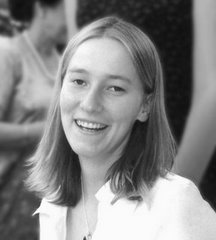
Press Release from the Parents of Rachel CorrieOur daughter Rachel, a volunteer with the International Solidarity Movement in the Occupied Territories, died Sunday in the Gaza Strip while courageously trying to prevent the demolition of a Palestinian home. Our loss is immense, but we are buoyed by the outpouring of support and love that we’ve received from around the world. We understand that Rachel is being remembered in many places in many beautiful ways, and we are grateful. We are comforted and heartened by the compassionate expressions of love that we have received from both Palestinian and Israeli people. We will forever remember and be thankful for Rachel’s ISM and Palestinian friends who cared for her and who held her for us as she died.We are speaking out today because of Rachel’s fears about the impact of a war with Iraq on the people in the Occupied Territories. She reported to us that her Palestinian friends were afraid that with all eyes on Iraq, the Israeli Defense Forces would escalate activity in the Occupied Territories. Rachel wanted to be in Gaza if that happened.In the last six weeks, Rachel became our eyes and ears for Rafah, a city at the southern tip of Gaza. Now that she’s no longer there, we are asking members of Congress and, truly, all the world to watch and listen.One week ago I came rather timidly to members of Rachel’s delegation in Congress, expressing my concerns for the safety of those in the International Solidarity Movement. A piece of me wonders if I had spoken louder or sooner, if this week’s tragedy might have been averted. So today I am speaking up in memory of my daughter and on behalf of all her friends in Gaza.We are greatly concerned for the non-violent internationals volunteering in the Occupied Territories. We ask that members of Congress call upon the Israeli government to cease harassment of these individuals and, specifically, to cease firing upon them when they are engaged in protecting the Palestinian water supply, protecting Palestinian homes from illegal demolitions, and retrieving bodies of murdered Palestinians for return to their families – all events Rachel witnessed.In my last phone conversation with Rachel, she expressed that when we fail to support and protect the Internationals who resist non–violently, we also undercut the non-violent initiatives of the Palestinians. We are, therefore, asking our members of Congress to demand that the American Embassy in Tel Aviv, when called upon for assistance, provide all reasonable support to non-violent, American volunteers in the Occupied Territories, as well as support to other internationals as appropriate.We are asking members of Congress to bring the U.S. government’s attention back to the Israeli-Palestinian crisis and to recognize that the occupation of the Palestinian territories is an overwhelming and continuous act of collective violence against the Palestinian people. We ask that military aid to Israel be commensurate with its efforts to end its occupation of the Palestinian Territories and to adhere to the rules of international law.Rachel would not want her death to overshadow that of others. In barely glancing at headlines since word came of Rachel’s death, I note that many have died this week in the Occupied Territories – one a four-year-old child. I would like to be able to hold the mother of that child and to have her hold me.Yesterday, I looked at a publication entitled "Who Will Save the Children?" with photos of children who have died since September 2000 in Israel and in the Occupied Territories. I understand that the next publication will be dedicated to Rachel and will include her photograph. I want the mothers of these children to know that I have looked at the beaming faces of each of their babies and that I know how much the world has lost with the passing of each one of them.In one of her e-mails Rachel wrote, "Today as I walked on top of the rubble where homes once stood, Egyptian soldiers called to me from the other side of the border, ‘Go! Go!’ because a tank was coming. Followed by waving and "what’s your name?" There is something disturbing about this friendly curiosity. It reminded me of how much, to some degree, we are all kids curious about other kids: Egyptian kids shouting at strange women wandering into the path of tanks. Palestinian kids shot from the tanks when they peek out from behind walls to see what’s going on. International kids standing in front of tanks with banners. Israeli kids in the tanks anonymously, occasionally shouting - and also occasionally waving – many forced to be here, many just aggressive, shooting into the houses as we wander away." How I wish that the young man in the bulldozer that killed Rachel could have just stopped, hopped out, and talked to her. He would have met a beautiful soul.In another e-mail, Rachel wrote, "This has to stop. I think it is a good idea for us all to drop everything and devote our lives to making this stop. I don’t think it’s an extremist thing to do anymore. I really want to dance around to Pat Benatar and have boyfriends and make comics for my co-workers. But I also want this to stop. Disbelief and horror is what I feel. Disappointment. I am disappointed that this is the base reality of our world and that we, in fact, participate in it. This is not at all what I asked for when I came into this world. This is not at all what the people here asked for when they came into this world. This is not what they are asking for now. This is not the world you and Dad wanted me to come into when you decided to have me."Rachel’s brutal death illustrates dramatically the madness of war.

Craig and Cindy Corrie

Ethiopian troops in Somalia ambush

Abdullahi Yusuf Ahmed, the Somali president, hopes to bring stability to his country [AFP]
Posted By Aljazeera.net


A convoy of Ethiopian troops has been ambushed in Mogadishu, the Somali capital, just hours after government troops repelled an attack on the president's palace.

At least one bystander was killed in the fighting that erupted after unknown men attacked the military convoy with machineguns and rocket-propelled grenades on Saturday morning.
bodyVariable350="Htmlphcontrol1_lblError";
The Ethiopian troops responded to the ambush by returning fire with heavy weapons. Some accounts said that as many as four people were killed in the ensuing firefight.

The government played down the attack, dismissing speculation that it was part of a broader anti-government offensive.
bodyVariable300="Htmlphcontrol2_lblError";
"Neither government forces nor our Ethiopian friends suffered any casualties in the attack, which was carried out by simple gunmen to show the international community that Mogadishu is still very unsafe," Abdirahman Dinari, a government spokesman, said.
Several people were also wounded in the brief exchange of fire.

"The Ethiopians shot me," Ali Kheyre Mumin, one of the wounded, said. "They shot at me and the others indiscriminately ... they shot everybody who was moving around."

A senior leader of the Union of Islamic Courts, which controlled Mogadishu and much of southern Somalia until December, took credit for the attack.

"This is a new uprising by the Somali people," Ahmed Qare, deputy chairman of the movement, told the Associated Press.

"The only solution can be reconciliation and talks between the transitional federal government and the Islamic courts."

The attack is the latest of several targeting Ethiopian troops who helped Somali's weak government drive fighters from the Union of Islamic Courts out of the Somali capital last month.

Presidential compound attacked

Late on Friday, attackers fired three mortars into the presidential compound and then engaged guards in a 30-minute fire fight, residents living nearby said.

Ethiopian and government troops riding tanks and heavily armed trucks rolled out of the compound and immediately sealed off the area

There were no reports of casualties.
The president and prime minister were in Mogadishu, but their exact whereabouts were unclear.

Dinari, the government spokesman, said one shell hit the presidential palace, known as Villa Somalia, but that no one inside was injured or killed.

"Those who ambushed the presidential palace escaped, and this is a cowardly act intended to terrorize the public," Dinari said.

The attacks have increased pressure on the Ethiopian troops to withdraw from Somalia.

The African Union has it wants to send troops to replace the Ethiopians but it has yet to prove that it has the troops, money or logistical capability to keep the peace in Somalia.

Somalia has lacked a functioning central government since the authoritarian government of Muhammad Siad Barre was toppled in 1991.

Thursday, January 18, 2007

How racism has invaded Canada

By Robert Fisk - 10 June 2006

http://news.independent.co.uk/world/fisk/article754394.ece
http://www.informationclearinghouse.info/article13575.htm
This has been a good week to be in Canada — or an awful week, depending on your point of view - to understand just how irretrievably biased and potentially racist the Canadian press has become. For, after the arrest of 17 Canadian Muslims on “terrorism” charges, the Toronto Globe and Mail and, to a slightly lesser extent, the National Post, have indulged in an orgy of finger-pointing that must reduce the chances of any fair trial and, at the same time, sow fear in the hearts of the country’s more than 700,000 Muslims. In fact, if I were a Canadian Muslim right now, I’d already be checking the airline timetables for a flight out of town. Or is that the purpose of this press campaign?
First, the charges. Even a lawyer for one of the accused has talked of a plot to storm the Parliament in Ottawa, hold MPs hostage and chop off the head of Prime Minister Stephen Harper. Without challenging the “facts” or casting any doubt on their sources — primarily the Royal Canadian Mounted Police or Canada’s leak-dripping Canadian Security Intelligence Service (CSIS) — reporters have told their readers that the 17 were variously planning to blow up Parliament, CSIS’s headquarters, the Canadian Broadcasting Corporation and sundry other targets. Every veiled and chadored Muslim woman relative of the accused has been photographed and their pictures printed, often on front pages. “Home-grown terrorists” has become theme of the month — even though the “terrorists” have yet to stand trial.
They were in receipt of “fertilizers”, we were told, which could be turned into explosives. When it emerged that Canadian police officers had already switched the “fertilizers” for a less harmful substance, nobody followed up the implications of this apparent “sting”. A Buffalo radio station down in the US even announced that the accused had actually received “explosives”. Bingo: Guilty before trial.
Of course, the Muslim-bashers have laced this nonsense with the usual pious concern for the rights of the accused. “Before I go on, one disclaimer,” purred the Globe and Mail’s Margaret Wente. “Nothing has been proved and nobody should rush to judgment.” Which, needless to say, Wente then went on to do in the same paragraph. “The exposure of our very own home-grown terrorists, if that’s what the men aspired to be, was both predictably shocking and shockingly predictable.” And just in case we missed the point of this hypocrisy, Wente ended her column by announcing that “Canada is not exempt from home-grown terrorism”. Angry young men are the tinderbox and Islamism is the match.
The country will probably have better luck than most at “putting out the fire”, she adds. But who, I wonder, is really lighting the match? For a very unpleasant — albeit initially innocuous — phrase has now found its way into the papers. The accused 17 — and, indeed their families and sometimes the country’s entire Muslim community — are now referred to as “Canadian-born”. Well, yes, they are Canadian-born. But there’s a subtle difference between this and being described as a “Canadian” — as other citizens of this vast country are in every other context. And the implications are obvious; there are now two types of Canadian citizen: The Canadian-born variety (Muslims) and Canadians (the rest).
If this seems finicky, try the following sentence from the Globe and Mail’s front page on Tuesday, supposedly an eyewitness account of the police arrest operation: “Parked directly outside his ... office was a large, gray, cube-shaped truck and, on the ground nearby, he recognized one of the two brown-skinned young men who had taken possession of the next door rented unit...” Come again? Brown-skinned? What in God’s name is this outrageous piece of racism doing on the front page of a major Canadian daily? What is “brown-skinned” supposed to mean — if it is not just a revolting attempt to isolate Muslims as the “other” in Canada’s highly multicultural society? I notice, for example, that when the paper obsequiously refers to Toronto’s police chief and his reportedly brilliant cops, he is not referred to as “white-skinned” (which he most assuredly is). Amid this swamp, Canada’s journalists are managing to soften the realities of their country’s new military involvement in Afghanistan.
More than 2,000 troops are deployed around Kandahar in active military operations against Taleban insurgents. They are taking the place of US troops, who will be transferred to fight even more Muslims insurgents in Iraq.
Canada is thus now involved in the Afghan war — those who doubt this should note the country has already shelled out $1.8bn in “defense spending” in Afghanistan and only $500m in “additional expenditures”, including humanitarian assistance and democratic renewal (sic) — and, by extension, in Iraq. In other words, Canada has gone to war in the Middle East.
None of this, according to the Canadian foreign minister, could be the cause of Muslim anger at home, although Jack Hooper — the CSIS chief who has a lot to learn about the Middle East but talks far too much — said a few days ago that “we had a high threat profile (in Canada) before Afghanistan. In any event, the presence of Canadians and Canadian forces there has elevated that threat somewhat.” I read all this on a flight from Calgary to Ottawa this week, sitting just a row behind Tim Goddard, his wife Sally and daughter Victoria, who were chatting gently and smiling bravely to the crew and fellow passengers. In the cargo hold of our aircraft lay the coffin of Goddard’s other daughter, Nichola, the first Canadian woman soldier to be killed in action in Afghanistan.
The next day, he scattered sand on Nichola’s coffin at Canada’s national military cemetery. A heartrending photograph of him appeared in the Post — but buried away on Page 6. And on the front page? A picture of British policemen standing outside the Bradford home of a Muslim “who may have links to Canada”. Allegedly, of course.

Emergency landing for Minister

Norway's Foreign Minister Jonas Gahr Støre was aboard a plane forced to land in Kandahar in southern Afghanistan on Wednesday
Støre and bodyguards, co-workers and a group of Norwegian press were supposed to return to capital Kabul after a visit to Tirin Kot in the south of the country in an Australian transport plane. Only upon landing did the passengers learn that they were in Kandahar, reputed to be the most dangerous city in the country.
"I thought we had landed in Kabul," said a surprised Støre after emerging onto the landing strip in the darkness. From there he was taken to a provisional terminal building.
Problems with air pressure aboard the plane forced the landing, as the plane was unable to rise above the mountains surrounding the Afghan capital.
As night began to fall there was doubt that either the plane or a replacement would be ready in time to transport the group to Kabul on Wednesday. Støre, who is on a three-day visit to Afghanistan, was preparing for a night in Kandahar under uncertain conditions.
Kandahar has been the scene of recent fighting between NATO soldiers and Taliban insurgents.
Posted by aftenposten
(Aftenposten English Web Desk/NTB)

Sunday, January 14, 2007

Saddam's half brother hanged

By jumana.heresh@aljazeera.net


Saddam Hussein's half brother and the former head of Iraq's revolutionary court are reported to have been hanged.
Barzan Ibrahim, Saddam's half brother and former intelligence chief, and Awad Hamed al-Bandar, the ex-head of Iraq's Revolutionary Court, had been found guilty along with Saddam in the killing of 148 Shiite Muslims.
bodyVariable350="Htmlphcontrol1_lblError";
Munqith al-Faroon, an Iraqi prosecutor, confirmed the deaths to the Associated Press news agency only two weeks and two days after Saddam was executed in chaotic scenes that drew worldwide criticism.

Jalal Talabani, the Iraqi president, last week urged the government to delay the executions.

Saturday, January 13, 2007

Ahmadinejad on Latin America tour

Ahmadinejad is locked in a tense standoff with the US over uranium enrichment and influence in Iraq [AFP]
Posted By Aljazeera.net

The Iranian president has left on a Latin American tour of Venezuela, Ecuador, Bolivia and Nicaragua, countries whose governments are critical of Washington.

bodyVariable350="Htmlphcontrol1_lblError";
Mahmoud Ahmadinejad will hold talks with his ideological "brother" Hugo Chavez, the Venezuelan president, on the start of his tour.

In Caracas, the two leaders were expected to sign a series of new trade and economic co-operation agreements.
bodyVariable300="Htmlphcontrol2_lblError";
"Iran and Venezuela are two important allies on a global level, the two countries have important industrial and oil projects which we will follow up in this trip," Ahmadinejad said before flying from Tehran.

Ahmadinejad has praised Chavez for his outspoken support of Iran's nuclear program, which the US and European governments say is part of a project to build atomic weapons.

Facing sanctions imposed by the UN Security Council over its uranium enrichment work and the threat of international isolation, Iran is keen to demonstrate it has backing among a number of leaders in Latin America.

Venezuelan support

Chavez is the most vocal supporter in Latin America for Iran and its president, with both men calling each other "brother" and relishing their status as fierce opponents of Washington's influence.
"Hugo is my brother," Ahmadinejad said during his last visit to Venezuela in September, when the two leaders inaugurated a joint oil well. "Hugo is the champion of the fight against imperialism."

In September 2005, Venezuela was alone in opposing a resolution at the International Atomic Energy Agency (IAEA) that found Iran in violation of nuclear safeguards. Since then, Chavez has completely backed Iran's right to enrich uranium.

Iran and Venezuela are both important players in the Organisation of Petroleum Exporting Countries (Opec) and have signed numerous co-operation agreements in the energy sector and other fields.

During a visit to Iran last September, Chavez came out in support of Iran's nuclear program, as well as denouncing Israeli military operations in Lebanon.

The two presidents also signed deals covering iron and steel production, petrochemicals, pharmaceuticals and health care equipment, and munitions.

While Ahmadinejad seeks to cultivate Latin American allies, Condoleezza Rice, the US secretary of state, has headed to the Middle East to rally Arab support for a new US strategy in Iraq and to counter Iran's alleged interference in Iraq.

Before her departure, Rice warned that the United States would not be passive in the face of what she called Iran's "regional aggression".

"I think you will see that the United States is not going to simply stand idly by and let these activities continue," she said.

Ecuador ceremony

After his one-day visit to Caracas, Ahmadinejad plans to head to Managua to hold talks with Daniel Ortega, Nicaragua's president and a US Cold War foe.

On Monday, Ahmadinejad will take part in the swearing-in ceremony of Ecuador's new president Rafael Correa, who has vowed to forge stronger ties with Venezuela and not to renew a lease for a US military air base on the country's Pacific coast.
The Iranian president will also hold meetings with other South American presidents including Bolivia's Evo Morales on the sidelines of the ceremony in Ecuador, before finishing his tour on Tuesday.

Thursday, January 11, 2007

Bangladesh president quits interim government, delays election

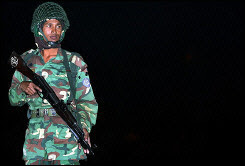
A Bangladeshi military soldier secures his position near the presidential palace in Dhaka. Bangladesh's president buckled to massive opposition and international pressure by quitting his role as head of an interim government and promising "free and fair" elections for the country.
Bangladesh's president buckled to massive opposition and international pressure by quitting his role as head of an interim government and agreeing to postpone disputed national elections.
.
President Iajuddin Ahmed's announcement came hours after he declared a state of emergency in a bid to tackle worsening violence generated by opposition allegations that the polls, scheduled for January 22, would be rigged.
.
New elections at a later date, the president promised in his dramatic U-turn, would be "free and fair".
.
"I have decided to resign as head of the caretaker government, to pave the way for an acceptable election in which all political parties can participate," the president said in a televised speech to the nation.
.
"The new caretaker government will hold dialogue with all the parties, and prepare for new elections within the shortest possible time," he said.
.
His temporary replacement as head of the interim government, responsible for organising the vote, is Supreme Court judge Fazlul Haq -- widely seen as being politically independent.
.
Ahmed will continue to serve as figurehead president.
.
The opposition, led by the left-leaning Awami League, said the announcement was a "victory for the people".
.
They had alleged the planned election would be biased in favour of the outgoing Bangladesh Nationalist Party (BNP), and have demanded a complete overhaul of an electoral list said to contain 14 million ghost voters.
.
"By admitting that the voter list had errors, and quitting as head of the interim government, he has in fact accepted our main demands," opposition spokesman Abdul Jalil told AFP.
.
The opposition had also promised a boycott and a series of non-stop protests, blockades and strikes, meaning the politically-polarised nation was facing -- as the president put it -- a "grave situation".
.
Ahmed said the pre-poll unrest and the loss of dozens of lives, meant it had become a "necessity to declare an emergency", involving a ban on all political activities and a curfew from 11:00 pm to 5:00 am.
.
"It is the expectation of the people to have a free and fair elections... that are acceptable to all parties, at home and abroad," the embattled president said, just a day after he had called 60,000 troops out on the streets.
.
Analysts said the state of emergency and announcement was likely to restore immediate calm to the country, as weeks of protests give way to intense negotiations between the rival parties.
.
Ahmed's decision came after the United Nations said it had suspended "all technical support to the electoral process" and warned it was concerned for the future of the country's democracy.
.
The European Union said it had suspended its election observation mission to Bangladesh, one of the poorest, most corrupt and densely-populated nations on earth.
.
Britain, the former colonial power, also condemned plans to hold elections regardless of the opposition boycott.
.
And crucially, the UN threatened to strip the Bangladeshi army of its prestigious and lucrative international 'blue helmet' peacekeeping duties if it backed elections with no opposition participation.
.
UN peacekeeping missions and the income they generate are highly prized in the Bangladeshi armed forces, and such a warning would have subjected the president to serious pressure to delay the polls, analysts said.
.
The Muslim-dominated but secular country of 144 million, formerly known as East Pakistan, has a history of instability, coups and counter coups since winning independence from Pakistan in 1971.
.
Although democracy was restored in 1991, the Awami League and the BNP have each regularly boycotted parliament and staged national strikes as a negotiating tactic when in opposition.
.
The crisis has also badly damaged the country's economy, with exports including from the crucial textile sector held up at Chittagong, home to the country's largest port. — AFP
Bangladesh's president buckled to massive opposition and international pressure by quitting his role as head of an interim government and agreeing to postpone disputed national elections.
.
President Iajuddin Ahmed's announcement came hours after he declared a state of emergency in a bid to tackle worsening violence generated by opposition allegations that the polls, scheduled for January 22, would be rigged.
.
New elections at a later date, the president promised in his dramatic U-turn, would be "free and fair".
.
"I have decided to resign as head of the caretaker government, to pave the way for an acceptable election in which all political parties can participate," the president said in a televised speech to the nation.
.
"The new caretaker government will hold dialogue with all the parties, and prepare for new elections within the shortest possible time," he said.
.
His temporary replacement as head of the interim government, responsible for organising the vote, is Supreme Court judge Fazlul Haq -- widely seen as being politically independent.
.
Ahmed will continue to serve as figurehead president.
.
The opposition, led by the left-leaning Awami League, said the announcement was a "victory for the people".
.
They had alleged the planned election would be biased in favour of the outgoing Bangladesh Nationalist Party (BNP), and have demanded a complete overhaul of an electoral list said to contain 14 million ghost voters.
.
"By admitting that the voter list had errors, and quitting as head of the interim government, he has in fact accepted our main demands," opposition spokesman Abdul Jalil told AFP.
.
The opposition had also promised a boycott and a series of non-stop protests, blockades and strikes, meaning the politically-polarised nation was facing -- as the president put it -- a "grave situation".
.
Ahmed said the pre-poll unrest and the loss of dozens of lives, meant it had become a "necessity to declare an emergency", involving a ban on all political activities and a curfew from 11:00 pm to 5:00 am.
.
"It is the expectation of the people to have a free and fair elections... that are acceptable to all parties, at home and abroad," the embattled president said, just a day after he had called 60,000 troops out on the streets.
.
Analysts said the state of emergency and announcement was likely to restore immediate calm to the country, as weeks of protests give way to intense negotiations between the rival parties.
.
Ahmed's decision came after the United Nations said it had suspended "all technical support to the electoral process" and warned it was concerned for the future of the country's democracy.
.
The European Union said it had suspended its election observation mission to Bangladesh, one of the poorest, most corrupt and densely-populated nations on earth.
.
Britain, the former colonial power, also condemned plans to hold elections regardless of the opposition boycott.
.
And crucially, the UN threatened to strip the Bangladeshi army of its prestigious and lucrative international 'blue helmet' peacekeeping duties if it backed elections with no opposition participation.
.
UN peacekeeping missions and the income they generate are highly prized in the Bangladeshi armed forces, and such a warning would have subjected the president to serious pressure to delay the polls, analysts said.
.
The Muslim-dominated but secular country of 144 million, formerly known as East Pakistan, has a history of instability, coups and counter coups since winning independence from Pakistan in 1971.
.
Although democracy was restored in 1991, the Awami League and the BNP have each regularly boycotted parliament and staged national strikes as a negotiating tactic when in opposition.
.
The crisis has also badly damaged the country's economy, with exports including from the crucial textile sector held up at Chittagong, home to the country's largest port. — AFP

Monday, January 08, 2007

Les Don Quichotte lèvent les camps... doucement - The Gift Quichotte raise the camps gently…

REUTERS
L'association a déclaré lundi la fin des campements en France, après l'annonce par le gouvernement de la création de 27000 nouvelles places d'hébergement d'urgence. Cependant, de nombreux SDF refusent de partir tant que des solutions ne sont pas concrètement appliquées.
Association declared Monday the end of the campings in France, after the advertisement by the government of the creation of 27000 new places of emergency lodging. However, of many SDF refuse to leave as long as solutions are not concretely applied.


«On lève les camps.» C'est par ces mots que le porte-parole des Enfants de Don Quichotte, Augustin Legrand, a annoncé lundi à Paris que l'association entamait «immédiatement un processus qui mettra fin à tous les campements» de sans-abri qu'elle a installés à travers la France. L'annonce a été faite devant un parterre de journalistes venant de tous les pays qui ont attendu la «star», comme le surnomme certains SDF, pendant plus d'une demi-heure. Juché sur un escalier au bord du canal, Legrand, qui lisait un texte, a ajouté dans son mégaphone : «Un changement radical de politique concernant les sans-abri et la certitude qu'un droit au logement opposable sera adopté prochainement dans un vrai esprit de consensus politique et associatif, nous conduisent à une sortie de crise immédiate.» «Un plan d'urgence est mis en œuvre dès aujourd'hui et nous démarrons immédiatement le processus qui nous conduira à la fin de tous les campements», a-t-il ajouté au bord du canal Saint-Martin où l'association a installé un campement de tentes depuis le 16 décembre, mettant le problème du logement au centre de l'actualité. Il a également ajouté que «la charte des Enfants de Don Quichotte avait été acceptée dans tous ses principes». Visiblement excédé par près d'un mois de lutte, le porte-parole n'a pas souhaité commenter le communiqué distribué aux journalistes. Il a tenu à préciser qu'il «partait dans l'heure» et qu'il n'avait «pas le temps de répondre aux quarante questions des journalistes». Direction l'Afrique du Sud et un tournage d'une durée de trois semaines. Les SDF ne sont pas prêts à lever le camp pour autant. Jean-Baptiste Legrand, le frère d'Augustin a précisé qu'ils allaient «plier les tentes au fur et à mesure que les SDF vont retrouver un logement», en précisant que cela pourrait prendre «plusieurs semaines» avant que le campement de quelque 250 tentes soit levé. Les sans-abri présents sont d'ailleurs sceptiques devant les promesses du gouvernement. Christian, un SDF présent sur le campement parisien, s'emporte. Pour lui, «tout ça c'est des promesses, c'est bidon». Et lui, comme tant d'autres, ne bougera pas tant que il n'y aura rien de concret. A Lille, les Don Quichotte annoncent qu'ils souhaitent rester 48 heures devant le parvis de l'église Saint-Maurice, «le temps que chacun trouve une solution de logement». A Nice aussi, les Don Quichotte refusent de partir. Les quelque 30 tentes installées sur la plage centrale ne seront pas démontées avant que «tout le monde soit relogé», a indiqué Robert Bourgeois, un porte-parole local de l'organisation. Reclamant de la considération, les Don Quichotte niçois veulent être consultés avant toute signature d'accord au niveau national. Peu avant cette annonce, le ministre de la Cohésion sociale, Jean-Louis Borloo, et le ministre délégué à la Cohésion sociale, Catherine Vautrin, que les Enfants de Don Quichotte avaient rencontrés ce week-end, avaient annoncé un «plan d'action renforcé» pour 2007 afin d'héberger de façon «pérenne» et «adaptée» toute personne accueillie en urgence, qui «s'appuiera sur 27.100 places nouvelles». Ils ont également confirmé que le gouvernement présentera un projet de loi instituant un droit au logement opposable.
.......In English.......
“One raises the camps.” It is by these words that the spokesman of the Children of Gift Quichotte, Augustin Legrand, announced Monday in Paris that association immediately started “a process which will put an end to all the campings” of homeless person that it installed through France. The advertisement was made in front of a floor of journalists coming from all the countries which awaited the “star”, as certain SDF call it, during more than one half an hour. Perched on a staircase at the edge of the channel, Legrand, which read a text, added in its loud-hailer: “A radical change of policy concerning the homeless people and the certainty which a right to opposable housing will be adopted soon in a true spirit of political and associative consensus, lead us to an exit of immediate crisis.” “An emergency plan is implemented as of today and we immediately start the process which will lead us at the end of all the campings”, it added at the edge of the Saint Martin's day channel where association installed a camping of tents since December 16, putting the housing problem at the center of the topicality. It also added that “the charter of the Children of Gift Quichotte had been accepted in all its principles”. Obviously exceeded by nearly one month of fight, the spokesman did not wish to comment on the official statement distributed to the journalists. He made a point of specifying that he “left in the hour” and that he did not have “not time to answer the forty questions of the journalists”. Direction South Africa and turning a one three weeks duration. The SDF are not ready to raise the camp for as much. Jean-baptiste Legrand, the brother of Augustin specified that they were going “to fold the tents as the SDF will find a housing”, by specifying that that could take “several weeks” before the camping of some 250 tents is raised. The homeless people present are skeptics besides in front of the promises of the government. Christian, a SDF present on the Parisian camping, carries himself. For him, “all that they is promises, it is can”. And him, like so much of others, will not move as much as there will be nothing concrete. In Lille, the Gift Quichotte announce that they wish to remain 48 hours in front of the square of the Saint-Maurice church, “time that each one find a solution of housing”. In Nice also, the Gift Quichotte refuse to leave. The few 30 tents installed on the central beach will not be dismounted before “everyone is rehoused”, indicated Robert Bourgeois, a local spokesman of the organization. Claiming consideration, the Gift Quichotte niçois want to be consulted before any signature of agreement at the national level. Little before this advertisement, the Minister for social Cohesion, Jean-Louis Borloo, and the minister delegated to social Cohesion, Catherine Vautrin, that the Children of Gift Quichotte had met this weekend, had announced a “action plan reinforced” for 2007 in order to lodge in perennial” and “adapted” way a “any person accomodated in urgency, which “will be based on 27.100 new places”. They also confirmed that the government will present a bill instituting a right to opposable housing.