The greatest obstacle to discovery is not ignorance, it is the illusion of knowledge
Sunday, February 24, 2008


Wednesday, January 16, 2008
American missile shield system
 American missile shield system
Definition of the system and the position of the American administrations - the rationale to justify the American system - reflections and reactions Almtoukahowla strategy: level Alaalmithania: in the Middle East With the advent of the new American administration Republic returned System Shield American anti-missile (National Missile Defense - NMD) and issued agenda concerns in the international arena since the administration announced its decision to proceed with the implementation of this project, which the Clinton administration had postponed a decision on it at a crucial year. Combines observers on the existence of security reflections of the system affect the strategic balance between the big powers, namely the United States, China, Russia, and also affect the international treaty limiting the proliferation of ballistic missiles, the prohibition of nuclear weapons, and accelerate the arms race and destabilize the international balance in general and the Middle East in particular. The definition of the position of the American administrations Definition of the system: "means a shield American anti-missile" building protection networks composed of ground missile systems, based on the geographic focal points of several, capable of shooting down any missile ballistic missiles aimed at passing American land. This system - if implemented - applied for the first time in the world by major country, which is prohibited by the Treaty on the Limitation of ballistic weapons (ABM), which went roadmap deliberately keep the airspace open, unprotected view to finding mutual deterrence between the major countries. The threat potential sources upon which the American system strategy Shield and expected departure missile attack against the United States is primarily Iran, Iraq, North Korea, Cuba and any country fall under the classification of "rogue States", as adopted by Washington. As is clear occupies two important Ostitan East, one Arab and other Islamic site "heart" in the sources of threat to the United States and encouraging the construction of this system. Meanwhile, the process of advancing Iran and Iraq because existing American detente in relations - North Korean and continues to expect internal collapse of the latter in the coming years and increase the likelihood of integration with the South Korean section as the integration of East Germany with the West, this is the one hand and on the other hand due to the deteriorating economic conditions in Cuba, which seems to be the other in the final fifteen minutes of her revolutionary, and expected many to conclude after an absence Castro. Even his presence back militarism and menacing supposed to problems of poverty and the economy exhausted and the efforts to maintain the cohesion of the state itself. American administrations position of the improvement noted beginning to return this issue strongly to the front of the international political events coincided with the election of George Bush and the Republicans the White House, who adopted the "acceleration" in the building of missile defense network as a national security issues that have been invested in the election campaign on the background of a "slowdown" shown by the Democrats to move forward with the project. The Clinton administration months of the recent decision has been taken to postpone a decision on the matter, which exploited until the end, Republicans accused their opponents of being Itrakhun to defend sensitive national security of the United States. The reasons for the postponement of the Clinton administration to take a crucial decision back to a combination of factors, including: Non get Russia and China, the European Union and hope to reach a compromise formula with those parties not provocative to implement the project. Deep suspicions in practical effectiveness of the entire system after the failure of several famous test launch test went fishing missiles to attack American targets on American land. The high financial cost of the program, which is in some estimates exceed forty billion dollars.This background showing their location by the missile defense strategy in electoral campaigns bid for the presidency important because it sets an initial question about how serious the risks assumed strategy and the extent of overstatement, which quickly pushed the idea that occupies huge "essence of American national security" in the next stage. American justifications to justify the Justifications cited by Washington for its allies and enemies alike are based mostly on two key elements: That the missile defense system is not causing any radical changes in the status quo of the global security and balance, this network is designed to repel missiles limited individual may give intentionally or by mistake on this state "rogue" or those, and not designed to - can not - be overwhelming repulsed an attack by missiles Menhmrh profusely Whether such an attack comes from Russia or China, the countries most affected by the imbalance caused by this network. Thus, the "mutual deterrence" by keeping international balance remains and fears of disruption of that balance between the major powers exaggerated. This network may evolve to include the future of NATO itself, and thus the harmony of the partnership with Europe rather than keeping away from them.
But the American justification involves example: It tends value of the project "defensive and propaganda" as a major essential component of a strategy the Republicans in defending the potential risks. If such a system can not effectively repel an attack from Russia or China, it is no exaggeration to give him and trying to persuade potential public opinion vitality and decentralize the region. The attempt this with the Washington marketing idea defense limited the effectiveness of the system remains surrounded by deep doubt, it is natural that the design of such a system taking into account the possibility converted and developed quickly, in emergency situations, to be able to repel the attacks heavy. The fact that any of the States that go to this system any "rogue States" on an advance suicide when it launched a missile against the United States. And discussion of this contradiction is the essence of the talk about the Middle Eastern dimension of the system. Reflections and reactions Strategy Expected Multiple levels of the strategic repercussions and reactions anticipated by the American missile defense system at the level of global security generally, and in the Middle East in particular: First: the level Alaalmimn expected to create implications of this system at the global level a climate similar to the Cold War atmosphere where security threats are global mutual continental arms race and paid enormous strides forward, due to a number of important strategic considerations, in the forefront: This system works on the strategic imbalance specifically with China and Russia can not be tolerated by those two countries. On one hand, if the process of completing its application provides the United States an unprecedented strategic superiority on those two leaving them Msfti back to the strategic vulnerability of utmost not Tslaha in maximum tension in the post-war era. The use of the system across the United States can bring down any ballistic missile based on it, in theory, from China or Russia, while not able either of these two refute any American rocket from the same level ballistic. In other words, at a time when the United States is immune from any rocket attack outside because they can irreversible countries of the world all be exposed to any American rocket attack since none of the nations of the world do not have the capacity buffer itself owned by the United States, a situation that did not happen strategic flawed in any time in past decades that followed World War II. This system works to expose convention limiting the spread of ballistic missiles (ABM) to the risk of cancellation. This Convention, which took place between the United States and the Soviet Union in 1972 had banned the establishment of such networks, national defense, and kept the airspace open and exposed to attack as a means of mutual deterrence to all States, where not make any state to use ballistic missiles intercontinental missiles for fear that the response will be in kind of by the State, which was exposed to an attack. Now theoretically the United States can progress so without fear of retaliation from the same type. Fear that this system will not only protect the land specifically American, and that it will not only be the first phase of the American security strategy "globalized" more serious than might appear at first glance. There will be subsequent stages in the context of this strategy aims to provide cover similar missile defense for Washington's allies, such as geographically distant from Japan, Taiwan, or on the borders of China and traveling vital and frustrate its supremacy in the regional, which brings the relaxed sleep eyes of Chinese strategists. Concern of the EU countries, ally across the Atlantic to Washington and the historic partner in NATO, from the system and felt that Washington does not receive not the Atlantic partnership to adopt strategies for global security, while criticizing it Alo'roureyen strongly when deciding on the European security alone and without consultation. The idea was met with severe criticism missile system and Brod, even before the Great State closest political and strategic to the United States. It may be noted that the increasing frequency of the draft shield American anti-missile accompanied by the European Bank for Atlantic escalation projects "Europeanization" security of the European continent through the formation of a European security force separate from NATO, or deepen component and the European identity of NATO itself. Despite all the criticism, direct or indirect attack on the American project by the European allies, and threats internalized the transatlantic partnership between the United States and Western Europe, Washington stubbornly insists on the move until posed with some voices from European prospects, even far-reaching that this the beginning of the disintegration of NATO and the same isolation United States and Europe each individual to establish a special security away from the long-standing partnership of the Second World War and the evolution of the cold war. Second: in the Middle Alaustrgem central strategy in the Middle East, the missile defense debate and controversy going around not give this parallel dimension size of its importance, particularly in terms of its negative effects on the region. There is no calculation for the opinion of the Governments and peoples of the region in their interest, particularly since the Arab states silent on the subject and heard no objection seriously by the United States does not pay even forced to explain and justify this program for the region's countries and public opinion. The dimension of the Middle Eastern American missile defense system in three dimensions: Serious allegations of threat to the security of states and cities by American missiles Iranian or Iraqi. Israel's role and its place in this system. Marketing missile defense systems in the Gulf region and the revitalization of American sales. First: Suppose sensation serious risk that both Iraq and Iran possess, or Simlkan, missiles that can hit American cities, as opposed to estimates of the UN disarmament committees at least as far as the side of Iraq. Although this hypothesis and to detect the seriousness of the allegation Iranian danger or the Iraqi question should be directed meditation and following it: Is it possible that Baghdad or Tehran to the suicide voluntary and even launch missiles at any one American city, in the light of estimating profits and losses as a result of this step? Is it possible to Baghdad in the light of the solution and continues to solve Iraq from destruction and siege at the hands of Washington and governed by the Iraqi file in the Security Council for ten years although it did not launch even one shot on any American city, as well as to launch a missile? Is it possible to provide Tehran in the light of the solution and still solve Iran because of the embargo and tighten the American - the western and without even fired one shot at the American land, as well as to launch a missile? Can any analysis equally strategic objective and rational say that the two countries are looking at the amount of retaliation and revenge event expected to step foot launch missiles against American cities? Allen asks decision-makers in the capitals of any of the proceeds of military, political and diplomatic than can be achieved against such adventure suicide? Wallis more logical to think the enemies of the United States in the Middle East, whether states or organizations who have, presumably, intercontinental missiles and worried Washington, that it is better for them a thousand times, that they want to go to war breaking bone with the United States to strike its interests in region instead fight a losing war across missiles against cities and lands? Probably say here that such accounts are inside the "rationality and rational policy," which does not apply to politicize any of the two countries, but in fact denies this statement through its policy of the two countries themselves in recent years, which is governed by profit and loss accounts especially in dealing with major countries and the United States in particular. Even possible to say that even step invasion of Kuwait, despite the wishes of, the decision has been taken when the Iraqi side to the logic of profit and loss accounts, and after that understanding Hints American, rightly or wrong, that Washington would not care about the case to step oldest Iraq's invasion of Kuwait. As to Iraq itself, subject to the profit and loss accounts of rationality at the height of his military defeat during the war did not resort to the use of nuclear or chemical weapons against the coalition armies application of the logic of estimating the response expected by the opponent. And applies to Iran, which refrained from engaging in the war according to the profit and loss accounts delicate political governed by the logic of a realistic and pragmatic. It also abandoned the idea of "exporting revolution" docile to the logic of political realism. It years ago to pursue a moderate foreign policy objective of changing the image of Iran in the West and the world of a "terrorist and fanatic" to a modern and rational. It is therefore likely even a 1% say that the Iraqi or Iranian missiles will be brought to the American territory in the coming years is, I do not deserve to be generated strategic missile defense searching for the enemy in parts of the earth. This eventuality is also assumed that the United States policy towards those countries had not changed and remained intransigent and not open. Certainly, the lack of possibility launching of an Iraqi or Iranian missile towards the United States will take hold in if Washington decided to adopt a policy of hostility towards the two lower heading towards cooperation and not beating the drums of war. If we have noted that the system of sanctions and the embargo on Iraq Il to the disintegration at the end of the day, and that the policy of moderation in the Iranian foreign policy is Baltrsch even among the hard-liners (especially in the decision-making circles military and strategic) may we expected the American relations - Iraqi and American - Iranian direction less escalation and hostile in the next ten years, despite what now seems tense sudden carrot review by the American administration Republic to prove oneself and chart a course different view different than any other clear goal, which means that the course will not go much will boomerang into reality says that the blockade Iraq is on the downtrend in the curve. For all this, the development of the two countries, Iraq and Iran, on top of the list of risks that threaten the delusional American national security is directly exaggeration meaningless unless it has other goals undeclared. Second: The location of Israel in the Aldvaaihna There intersections between Israeli missile defense strategy and its American spoke for the first time and justified in terms of the development of Iraq and Iran at the site of Advanced threatening to American national security, and notes on the future of the strategic relationship between the two parties and outward towards new horizons unprecedented. It is the first foundation for a strategic change that has occurred is on the agenda priorities of the Israeli strategy after the Gulf War and the arrival of Iraqi missile to Tel Aviv. Shortly war, and the impact of the failure of the American Patriot system in toppling Iraqi missile, Israel worked to develop the program tremendous Arrow missile systems aimed at establishing a network of missile defense is not penetrated by any Iraqi missile, or Iranian or Syrian or Egyptian. The United States engaged in the program from the outset strongly support and coordination, which made him more than $ 1.1 billion, as well as the substantive participation and bilateral programs. Israel has succeeded in the development of the sophisticated missile defense systems and facilities excelled at the American technology itself. Israel announced in the last quarter of last year, it published regulations Soaik Arrow defensive missile is protected from attack from abroad. In perspective, the Israeli threats against the first built Arrow defense system comes from Iraq and Iran. This means that the Israeli strategy here in line with their counterparts in the American perception that the threat to the territory of the two countries comes from Iraq and Iran. The new thing here is that this consensus is happening for the first time such depths, especially by the United States. Previously, Alnzertan match against American and Israeli sources danger in the Middle East against the "interests of the two countries" and not against "the territory of the two countries." The danger which threatens the "land of Israel" was not considered by the Americans a threat to their land (Syria, Egypt, Iraq, the PLO and the Soviet influence, and the States and the revolutionary organizations in the region ...). Now, because of active American policy escalating this consensus emerged and the evolution clearly fueling him certainly new patterns of tension "missile" will beset the region in the next phase. The imbalance missile defense systems and associated for Israel blatantly will not receive intimate reception by Arab capitals in the Orient. The rates will increase from the race and a further drain on resources of the region and opens a new chapter in the chapters of duplication of American policy in the region, which claims that it wants to support the development and stability in the region and on cords wars and tension. Third: Marketing defense systems in the American Alkhalijama third issue is linked to the idea above is the impact of the recent missile defense system on the attempts to market the American air defense systems in the Gulf. It certainly create an atmosphere "missile tension" in the region accompanied by several developments such as heating outlook hostile to Iraq and Iran from this angle, and the superiority of Israel in missile defense systems, and the disillusionment of Arab States, the Gulf states continue to notice the potential threat from Iran and Iraq, and oppose any Gulf collective security system that does not depend on the outside world, all that will expand the sales market American missile defense systems and invigorate. Did not leave the United States this in the guesswork and analysis by the William Cohen, Secretary of Defense, former American, in November 2000 to visit an expanded marketing in the Gulf by offering to engage in the "defense cooperation initiative", based on the deployment of Patriot batteries regimes in the region to intercept any missile attack (and presumably implies coming from Iraq or Iran). Strangely enough, the topic that these systems to be marketed on the Gulf States are the regulations for Feztha Israel because of ineffectiveness tested in the Gulf War, Israel and replaced by Alvaro missile systems. * Visiting Fellow, Department of Middle Eastern Studies and Islamic University in Cambridge.
Tuesday, October 23, 2007
Protests after Israel prison riot
 Violence broke out after guards began searching the prisoners' bunks [AFP]
A riot in an Israeli jail that left one inmate dead has provoked an angry response from other Palestinian prisoners and sparked protests in the occupied territories. The Prisoners Club, the main group representing Palestinian prisoners, said on Tuesday that most of the nearly 10,000 security detainees held in Israel had gone on hunger strike.
bodyVariable350="Htmlphcontrol1_lblError";
"This is a one-day hunger strike to protest against what happened at Ketziot," Issa Qaraqi, a Palestinian MP, said. However, Yarona Zamir, a spokeswoman for Israel's prison service, said that although some prisoners had refused their breakfast there was not a widespread hunger strike.
bodyVariable300="Htmlphcontrol2_lblError";
Clashes broke out at the Ketziot prison in the southern Negev desert early on Monday as about 1,000 inmates attacked prison guards and torched the tents where they were being held.The guards fought back with tear gas, rubber bullets and batons. At least 15 prisoners and 15 guards were injured in the violence. 'Non-lethal weapon'The Israeli prison service said that it was a "non-lethal weapon" that had injured the prisoner who later died in hospital.It did not reveal his identity, but said he was 30-years old and serving a two-year sentence.Ashraf Ajrami, minister of prisoner affairs in the Palestinian government, said he was Mohammed al-Ashkar, a member of the Islamic Jihad group. The relatively short sentence suggested his offence must have been minor, he said. Al Jazeera's Jacky Rowland in Ramallah said the violence at the Ketziot jail had provoked protests in the West Bank and Gaza Strip as almost every Palestinian family has a relative who is, or has been, a prisoner in Israel.Another protest was planned for the West Bank town of Ramallah on Tuesday.Rowland said the timing of the incident was important coming just weeks ahead of peace talks between Israeli and Palestinian leaders in the United States."Many Palestinians are saying, look if this type of thing going on just weeks before the peace talks what does it say about the extent to which the Israelis are really dealing in goodwill," she said.'Provocative' searchThe violence broke out after guards began searching prisoners' bunks for contraband.
The Prisoners Club said that the cell searches had been "provocative".Ajrami said the security sweep violated an agreement between the prisons service and inmates barring night-time searches and appeared to be aimed at intimidating imprisoned Palestinian fighters.
"It was intended to destroy the political movement," he said. "It was intended as an oppressive act."About 2,000 Palestinians are held at Ketziot, 700 of them have never had charges brought against them. The jail is set up like a military camp, with prisoners quartered in tents rather than buildings.
Monday, October 15, 2007
Israel and Hezbollah swap bodies
 Two bodies were exhumed from the Amiad military zone in northern Israel ahead of the exchange [AFP]
Lebanon's Hezbollah movement handed over the remains of an Israeli in exchange for a Lebanese prisoner and the bodies of two of the group's fighters.An Israeli military vehicle carrying the bodies of the dead Lebanese entered the no-man's zone along the border on Monday, crossing paths with Lebanese ambulances that were heading the other way.
bodyVariable350="Htmlphcontrol1_lblError";
Lebanese troops kept journalists and civilians away from the Naqoura crossing as the exchange took place.The two dead Hezbollah fighters went missing last summer during the 34 day war between the Shia Muslim group and Israel in southern Lebanon.
bodyVariable300="Htmlphcontrol2_lblError";
The identity of the Israeli body, that has arrived at the border in an ambulance accompanied by Hezbollah vehicles, was unclear।Al Jazeera's Rula Amin said from the Naqoura crossing that the body handed back to Israeli authorities was a civilian who died at sea and was washed up in Lebanon।Captured troopsLast year's conflict began after the Lebanese movement captured Eldad Regev and Ehud Goldwasser, two Israeli troops, and early reports had suggested that the remains being released were from a soldier.
Kuntar was to be freed at a later date in return for information on the fate of Ron Arad, an Israeli air force navigator who has been missing since October 1986 when his plane was shot down over southern Lebanon.An Israeli official tolf the AFP news agency that Hezbollah said it would provide information about Arad as part of Monday's deal. Kuntar was jailed for 542 years in 1980 for killing a scientist and his four-year-old daughter as well as an Israeli policeman.Bassam Kuntar, Samir's brother, told Al Jazeera that the exchange was a victory for Hezbollah and Lebanon."I think it is an additional victory for Lebanon and the Islamic resistance because we are speaking about the body of a civilian who was not captured during the July 2006 war," he said. Bassam said that Hezbollah would not give Israel any information about the two soldiers captured last July until his brother was released.Soldiers 'in Iran'Asharq Al-Awsat, an UK-based Arabic newspaper, reported on Sunday that the two Israelis had been handed to Iran and could be freed as part of a German-brokered exchange. It quoted a source identified as a high-ranking official in the office of Ayatollah Ali Khamenei, Iran's supreme leader, as saying they had been transferred by the country's elite Revolutionary Guards. Last week, Germany decided last week to free an Iranian agent jailed for life for the murder of four Kurdish dissidents in 1992 and the newspaper suggested that this could have been part of the deal.Rula Amin said Monday's exchange had also been arranged by a German negotiator.A senior Israeli government official dismissed the Asharq Al-Awsat report as "nonsense" and said it was an "attempt to dissiminate disinformation on this extremely sensitive issue."Germany also dismissed suggestions that the agent was released as part of a deal with तेहरान
Posted by aljazeera.net
Thursday, August 30, 2007
Sharif sets Pakistan return date
 Sharif said he would return to Lahore, his power base in the country's east
Nawaz Sharif, a former Pakistani leader, has said he will return home on September 10 to challenge General Pervez Musharraf, Pakistan's president, in forthcoming elections.
Sharif left Pakistan shortly after being ousted by Musharraf in a 1999 coup and risks arrest when he flies into capital Islamabad.
bodyVariable350="Htmlphcontrol1_lblError";
At a news conference on Thursday, Sharif said: "Why am I going back? To respond to the call of duty ... To achieve the supremacy of the rule of law and the constitution and to rid my people of dictatorship forever."
bodyVariable300="Htmlphcontrol2_lblError";
He described Musharraf's rule as illegitimate and said he would go straight to Lahore, his base of power in the east of the country, after landing in Islamabad.
Benazir Bhutto, another former prime minister, said on Wednesday that she had almost sealed a power-sharing deal with Musharraf under which he will quit as Pakistan's army chief.
But a presidential spokesman said on Thursday that Musharraf had yet to decide whether to step down as army chief.
Pakistan's Supreme Court ruled last week that Sharif, a two-time prime minister, should be allowed to return.
Sharif has vowed to oppose a bid by Musharraf for another term as president.
After he was overthrown, Sharif was sentenced to life in prison on graft and security charges. He was exiled in 2000.
With his term coming to an end and his popularity plummeting, Musharraf has turned to Bhutto for help to shore up his position, and his aides are meeting with the two-time prime minister in London.
But Bhutto has insisted an agreement would hinge on Musharraf stepping down as chief of the army, which has ruled for more than half Pakistan's history since independence in 1947.
'Setback'In an interview with the Financial Times published on Wednesday, Sharif, who is leader of the Pakistan Muslim League, called Bhutto's attempts to deal with Musharraf a "setback" and a "clear violation" of a deal agreed between them to do "no deals with military dictators".
In another development with potential political ramifications, Pakistan's supreme court agreed on Wednesday to hear an appeal against Musharraf's role as army commander.
The application was filed by Qazi Husssain Ahmed, the chief of Pakistan's main coalition of Islamist parties - the Muttahida Majlis-e-Amal, or United Action Front।
Pakistan's Supreme Court ruled last week that Sharif, a two-time prime minister, should be allowed to return.
Sharif has vowed to oppose a bid by Musharraf for another term as president.
After he was overthrown, Sharif was sentenced to life in prison on graft and security charges. He was exiled in 2000.
With his term coming to an end and his popularity plummeting, Musharraf has turned to Bhutto for help to shore up his position, and his aides are meeting with the two-time prime minister in London.
But Bhutto has insisted an agreement would hinge on Musharraf stepping down as chief of the army, which has ruled for more than half Pakistan's history since independence in 1947.
'Setback'In an interview with the Financial Times published on Wednesday, Sharif, who is leader of the Pakistan Muslim League, called Bhutto's attempts to deal with Musharraf a "setback" and a "clear violation" of a deal agreed between them to do "no deals with military dictators".
In another development with potential political ramifications, Pakistan's supreme court agreed on Wednesday to hear an appeal against Musharraf's role as army commander.
The application was filed by Qazi Husssain Ahmed, the chief of Pakistan's main coalition of Islamist parties - the Muttahida Majlis-e-Amal, or United Action Front।
Javed Iqbal, a judge of the court, said: "The petition is fixed for regular hearing."
He said that objections from the court registrar's office that Ahmed had no authority to lodge the appeal, were "devoid of merit".
Musharraf, who seized power in a bloodless military coup in 1999, is seeking re-election as president-in-uniform by parliament in September or October. "The people are fed up with the unconstitutional and dictatorial military regime," Ahmed said outside the court. The application says that under military regulations, Musharraf's term as chief of army staff had expired in 2001. Public pledge
The application also states that he was no longer eligible to continue in the post after turning 60 in August 2003. The legal challenge argues that in 2004, Musharraf had broken a public pledge to hang up his military uniform.
Musharraf has suffered a series of legal setbacks since his attempt in March to sack Iftikhar Muhammad Chaudhry, the chief justice of the supreme court। The court had reinstated Chaudhry in July after months of nationwide protests and then ruled last week that Nawaz Sharif, a former prime minister, could return from exile.
He said that objections from the court registrar's office that Ahmed had no authority to lodge the appeal, were "devoid of merit".
Musharraf, who seized power in a bloodless military coup in 1999, is seeking re-election as president-in-uniform by parliament in September or October. "The people are fed up with the unconstitutional and dictatorial military regime," Ahmed said outside the court. The application says that under military regulations, Musharraf's term as chief of army staff had expired in 2001. Public pledge
The application also states that he was no longer eligible to continue in the post after turning 60 in August 2003. The legal challenge argues that in 2004, Musharraf had broken a public pledge to hang up his military uniform.
Musharraf has suffered a series of legal setbacks since his attempt in March to sack Iftikhar Muhammad Chaudhry, the chief justice of the supreme court। The court had reinstated Chaudhry in July after months of nationwide protests and then ruled last week that Nawaz Sharif, a former prime minister, could return from exile.
Posted by aljazeera.net
Wednesday, May 30, 2007
Al-Qassam rocket

The current Israeli military onslaught on the Gaza Strip, land and air, entitled "eradicate the Hamas movement and the elimination of its military wing Al-Qassam Battalions", and the main cause, according to the political circles and the Israeli Foreign Ministry, is to stop Qassam rockets falling on Jewish settlements and communities adjacent to the Gaza Strip। What is the story of the Qassam rockets, and when it started, and what are the real effects on the Israelis, and any prospects may emerge from the current war, and the role of the Qassam rocket?
The beginnings of industrialization and the gradual evolution
Use of locally manufactured Qassam rocket, entered the Palestinian resistance, a new phase of confrontation, which managed whenever wants to threaten the security of Israeli soldiers and settlers, and an unconfirmed number of deaths, not to mention the greater number of casualties, by the fall of missiles at Jewish settlements and military positions, and the failure of all attempts to prevent the occupation army, resistance came with the occupation in the equation of a new conflict। Confessions and Israeli military sources themselves, formed the Qassam rockets which the military wing of Hamas basically prepared and manufactured, qualitative leap in the performance of the strategy and tactics of resistance, imposed themselves on the field and military arenas, although simplicity that characterize this tactic, and despite suffering from a crisis in the Palestinian issue has not witnessed for decades। The resistance forces fought the midst of the first experiment to produce missiles threaten local settlements in the Gaza Strip during the first year of the Al-Aqsa Intifada, specifically late 2001, raw materials, and engineers are keen to develop continuously, where production has been more than a generation of them.
The initial stages of the rocket production and the means to search for explosive materials, and has faced many obstacles and difficulties, was the lack of necessary materials in the occupied territories, which led the engineering and development units of the armed wings of self-reliance in the manufacture of all materials necessary for the requirements of the missile. According to data of the Qassam Brigades, the first rocket produced by engineers reached 70 cm in length and 8 cm in diameter, and ranged between 2-3 km range, and held in the foreword explosive warhead containing 600 grams of a substance (TNT) of high explosives, and will be launched by Dasher. In the beginnings of manufacturing miss missile accuracy correction towards the objectives, which form an incentive for continued development and debugging that emerged when, not so long ago even announced development, and production of a new model is "Qassam 2", especially after radical amendments, which can range from access to the inside Israeli groupings. The length of 180 cm, and the range of between 9-12 km, and increased his load of explosives to hit 6 kg of high explosive, while the diameter of 12 cm. This was the qualitative development of resistance to shed more light upon further analysis of the nature and military strength, and according to "Shlomo Gazit" former head of military intelligence, the Qassam rocket features several foremost primitive manufacturing, ease of production, cheap. There has been no radical change in the way the rocket launch only appropriate Pitcher of the appropriate size, and thus are not controlled sensing, showed a number of video, which was distributed to the media the way ambush and rocket launchers. Where is arrested diagonally to the holder of three legs, and the elements of the Qassam, a device similar to the compass to restructure space, and adjusted accordingly, so become a military style has achieved successes on various levels. According to data army of occupation, resistance launched since the withdrawal from Gaza in September 2005 and at the time of writing, almost 1000 rocket-propelled grenade. Note that the most important towns fired Qassam rockets are : Sderot, Kibbutz Evere, Kfar Sa'ad, Kfar Azza, Nahal Oz, Ilit, Kissufim, Native Aatsra, Karni crossing, Vikim, Nair year, Kirm Shalom Netivot. In a precedent, the first of its kind, Qassam rocket landed on the coastal city of Ashkelon, and not the result of the fall recall any injuries, but the form of an ultimatum to the security hotline, which describes the city as "strategic" to contain the largest power generation plant belonging to the Electricity Company, and a "CTSA", which stores fuel and gas. Rockets effects on the domestic front after the occupation of evolution in the nature of Qassam rockets, the method of delivery, are not stray, but it is rare for the settlements came without any injuries or damage. It is noteworthy that the Israeli media had initially counted the house or car of the settlers or the army for damages, described as "minor", but after it became the missiles hit targets, media started talking about the "number" of houses, buildings and cars damaged as "serious" by bombing।
While the firing of rockets is in the midst of extremely complex and dangerous in light of the continuing flight of the reconnaissance plane and helicopter gunships, it resulted in the injury of dozens of settlers and soldiers various injuries, with damaged and destroyed dozens of houses in the colonies and commercial complexes and factories, in addition to military positions. In a quick look at the rate of firing rockets over the past six years, we find continuous escalation rate equal more than 200% annually. Although primitive Qassam rockets and manufacture of manual, the impact is clear to the Israelis who did not hide the great resonance in successive statements. Arrived with some Western media outlets that give strategic dimensions connected prevailing balance of power, while it described as primitive missile, which may change the face of the Middle East, as part of what CNN that the paper fierce in the region, it is not clear how these primitive rockets that affect the military balance in the Palestinian-Israeli conflict, and make "high-Israeli force" standing helplessly stranded, with the BBC channel that this missile is a corrosive effect on the transfer of Israeli military super power. All agreed views the Israeli political and military alike, as Qassam rockets growing threat to the occupation forces and settlements in the same time. Such missiles have started targeting for the settlement of "Sderot" adjacent to the Gaza Strip within the borders of occupied Palestine in 48, have their strengths and weaknesses and superiority in Badaeitha, it is difficult to monitor high-tech devices owned by the occupation army, which forced the Israelis to recognize their inability to prevent the launch. In this context, he said, "Avi Dichter," chief of the security "Shabak" and former Minister of Internal Security in the current security report submitted to the government, that the firing of Qassam rockets salary in an impressive manner. There include orderly start research and development, followed by the production of parts, Valterkib, then the distribution of roles field and responsibility for the launch, saying that the presence of the army in the Gaza Strip does not necessarily help to prevent the launching of these rockets. With the transfer of the Chief of Research at the military intelligence "Yossi Kobervasser" The Hamas movement through these missiles continues in its attempts to commit attacks against Israel strategy, and disbanded still continue to produce combat means, including missiles. Military experts also showed considerable Israelis pessimistic about the future of dealing with such rockets processed manually, especially after it succeeded in toppling the theory of "protection through the wall." Making security forums diminish the usefulness of the wall because it is no longer able to guarantee the security of Israel, Fsarukh Qassam on the wall means less appropriate for the situation, even if it is the opposite of what the army was forced to enter Khanions and Rafah, or closure of the border with Egypt. He even went to some security reports to talk about the inability of the former Prime Minister "Ariel Sharon" to sleep because of the problem of the missiles, which the Palestinians succeed in the capital Imatarwa by Israelis after they do that has found it difficult to martyrdom operations inside the territories occupied in 48 because of stringent security measures.
The Knesset deputy said, "Yisrael Hasson," Israel has become a hostage of the rockets of Hamas! With the military correspondent "Amir Rbabort" positives rocket saying : Although there are many generations of technological gap between disarmament flour used by the army, and between primitive missile launched by Hamas on Ashkelon, it smart bomb Thanks to its psychological, because one missile introduced tens of thousands of Israelis to the horror! । As for the direct effects of the missiles on the Israelis, are reflected in the following scenes : 1-enter periodic underground shelters. 2-disruption of schooling in all schools and educational institutions. 3 - The streets of pedestrians and the settlements are subject to a curfew. 4-high flee settlements and the targeted populations. 5-send more psychologists to address population of panic and shock they suffer. The form of escalating resistance to the rocket bombardment on Gaza settlements and some residential settlement inside the Green Line adjacent to Gaza, a political and military crisis Israel, under pressure from settlers to halt the bombing of the expected deaths and injuries, and much more destructive than ever before, where revolted in large demonstrations in some cities, demanding cessation. Evaluation procedures for the army to prevent rocket steady development in the manufacture of rockets hand, and the security strategy and military on the other hand, prompted the military establishment represented in the army for the biggest and broadest military campaign against the Gaza Strip. Such as : Days of Penitence, Field of Thorns, Hell rolling, Defensive Shield, a color-track firm, Faris night, the rainbow, southern arrow, firm road, the first shower, and finally the current campaign, all aimed at preventing the firing of Qassam rockets, and all failed to prevent the firing of rockets, which continued in the period between precipitation and again, the army also used several means to the same objective, namely : 1-bombing industrial workshops and lathes and metal plants. 2-activating warning systems security inside the settlements adjacent to Gaza. 3-demand from the Palestinian Authority deploy its forces north of the Gaza Strip to prevent the firing of rockets. 4-providing more than $ 20 million to complete early warning devices, voice, and fortify buildings surrounding settlements sector, and the immediate immunization of institutions and buildings that are in the range of the Qassam rockets, and install sirens and broadcasting via early warning device known as the "red dawn."
However, the long arm of Israeli helpless and useless in the face of resistance successive innovations in the development of missiles, more than that, the Israeli Foreign Ministry, "severed hand" and began the process of begging for international assistance through diplomatic campaign to halt the firing of rockets। The many analysis by the inability to overcome the Qassam rockets, including what political commentator "Ben cassette" : should stand bravely before the truth ॥ There is no army at this moment missiles toward a solution, the only way the occupation of the Gaza Strip and the result is dozens of dead Israelis, the loss of political momentum, a return to recession, the loss of hope, and then crawl back to abroad to international pressure. With Professor "Michel Freund" : Thousands of Israelis hiding in their homes waiting for the Qassam rocket can download over their heads, through the roofs of their homes that can not protect them rain, army officers say that the rocket is inaccurate, well, but it might hit your head! . After the failure of all security solutions and treatments, the military tried and innovation army tries to prevent the firing of rockets, the government economic solutions of funding promises generous financial settlements, particularly "Sderot", a package of support, and preferential excess in the areas of welfare, education, industry, health and employment. In step comes within the framework of changing the departure of the settlers, the Knesset majority for a bill granting special populations in adjacent areas of the Gaza Strip facilities tax, up 13%, as one of the front lines, as ratified by the Ministry of Defense multi-faceted plan to fortify towns in the vicinity of Gaza, at a cost of $ 50 million. However basket failed promises, facilities and attractions that characterized the government to settlers in establishing trust with the spirit, and convince them to stay and not go. This came on the tongue of one's own country "Sderot" favorite target of a missile resistance when he said : our life here has turned into an unbearable hell, we can live in this manner, we can not close their eyes throughout the night, Nhamlk remain in the sky all the time for fear of Qassam surprises! .
Posted By Al-Jazeera.net
Translated by NewsClock.com
Translated by NewsClock.com
Thursday, May 24, 2007


Washington rejects Amnesty International accusations of violating human rights

The United States rejected accusations by Amnesty International to use the world "Square big battle" in the "war on terror", terming the OSCE report published in this regard "political document"। A spokesman for the State Department Tom Casey "it is quite clear that Amnesty International considers us an ideological process to be directed punches and, unfortunately, this is not anything new।" The annual report, which was published yesterday in London drew criticism of the United States, and believed that "the war on Iraq, the climate of fear in George Bush's administration published worldwide increased international divisions।" The report also accused Washington of "double discourse on human rights by portraying itself as the champion in the defense of these rights and the rule of law on one hand and the application of policies undermined the most elementary principles of international law at the same time" on the other hand. The report says that the United States these practices "that jeopardize security in the long term, undermine credibility in the international arena." Amnesty International pointed out that in "late 2006, the United States was still holding thousands of people without charge or trial in Iraq, Afghanistan and Guantanamo." The report stated that "there is no senior official in the American government was accountable for acts of torture and ill-treatment suffered by persons arrested under the so-called war on terrorism, despite evidence to suggest that the exercise of violence in a systematic way."
Secret prisons
and said Secretary General of the Organization Irene Khan that "Nothing reflects the globalization of human rights violations over the deportation sector", in reference to the transfer of hundreds of people illegally to countries such as Syria, Jordan and Egypt। She Khan regretted "the American government to continue the deaf ears of the whole world calls for the closure of Guantanamo।" She said that Washington was "not totally regretted the establishment of a wide network based on the violation of human rights in the name of fighting terrorism," and that the results of this policy is "retreat moral authority of the United States to its lowest in the world while the insecurity permeates more than ever." On the American policy in Iraq and described the Amnesty International American military intervention as a "very adventurous", and considered that this conflict has had negative consequences on human rights.
Saturday, May 12, 2007
Iraq attack kills five US soldiers

Major General William Caldwell said the whereabouts of three US soldiers was unknown
Posted by Aljazeera.net
Five US soldiers were killed and three went missing when their unit was attacked south of Baghdad, the US military has said.
The attack on a patrol of seven US soldiers and an Iraqi interpreter occured early on Saturday morning.
bodyVariable350="Htmlphcontrol1_lblError";
The US military said the attack took place at 4:44am near Mahmudiya, about 30km south of the capital.
Mahmudiya is a stronghold of Sunni Arab fighters opposed to the US-backed government in Iraq.
bodyVariable300="Htmlphcontrol2_lblError";
Troops who arrived later found five of the soldiers dead and the other three remained missing, according to a statement from Major-General William Caldwell, the chief US military spokesman in Iraq.
"The quick reaction force reported finding five members of the team killed in action and three others whose duty status and whereabouts are unknown," Caldwell said.
Search operations
The military refused to specify whether the Iraqi interpreter was among those killed or among the missing, citing security reasons.
Soldiers were searching for the missing, using drone planes and jets and setting up checkpoints throughout the area.
Soldiers were also trying to enlist support from local leaders for information.
Caldwell said: "Make no mistake: We will never stop looking for our soldiers until their status is definitively determined, and we continue to pray for their safe return."
The attack occurred nearly a year after two American soldiers went missing following a June 16 attack in the same area, prompting a massive search. Their bodies were found tied together with a bomb between one victim's legs several days later.
Two other US soldiers remain missing in action from the current conflict, including Sergeant Matt Maupin, of Batavia, Ohio, missing since April 2004 and Ahmed Qusai al-Taayie, a 41-year-old Iraqi-born reserve soldier from Ann Arbor, Michigan, who was abducted while visiting his Iraqi wife on October 23 in Baghdad.
Thursday, May 10, 2007
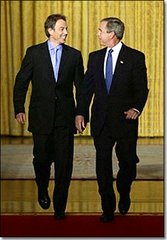
The British vampire is resigning
 Tony Blair the war vampire
 Darryl Cunningham the artist
Tony
NewsClock.com
The British vampire is resigning
Today the beginning of the end of Tony Blair the war vampire
The Guardian newspaper said British Prime Minister Tony Blair will announce his resignation today, Thursday, the leadership of the Labor Party in the same room, which was inaugurated by the start of a campaign leading to the party on June 11, 1994
The newspaper added that Blair would end the curtain on his leadership at the center, which the heirs of John Smith, he was able to achieve the success story electoral what has become known as the new Labor party.
So the British vampire is leaving the office after Killing more than 650,000 of Iraqi people under the name of freedom and fighting against terror. (do they think we are stupid maybe)
Today the beginning of the end of Tony Blair the war vampire
The Guardian newspaper said British Prime Minister Tony Blair will announce his resignation today, Thursday, the leadership of the Labor Party in the same room, which was inaugurated by the start of a campaign leading to the party on June 11, 1994
The newspaper added that Blair would end the curtain on his leadership at the center, which the heirs of John Smith, he was able to achieve the success story electoral what has become known as the new Labor party.
So the British vampire is leaving the office after Killing more than 650,000 of Iraqi people under the name of freedom and fighting against terror. (do they think we are stupid maybe)
Tony
NewsClock.com
Sunday, May 06, 2007
Israeli report reveals the cruel torture of Palestinian prisoners

Posted by aljazeera.net in Arabic and translated to English by NewsClock.com
Two Human right organizations in Haifa revealed that Israel is cruel torture against Palestinian prisoners and detainees brushing aside international instruments। She said the B'tselem human rights in the Palestinian territories and the status of individual rights in a joint report that today, Sunday, the Israeli General Security Service (Shabak) has torturing Palestinian detainees in ways that do not humane and multi-through investigation. According to the report, which is based certificates for 73 Palestinian prisoners in the period between July 2005 and March 2006 that 96% of the detainees were subjected to closer grasp for long periods in painful and that 64% of them had received threats and insults, cruel campus with 45% of sleep and hunger of 73%. In most cases - report adds-Chabak pursue ways to spare the captive from the outside world and the isolation of a few days of investigation and arrest humiliating conditions amid beatings and psychological pressure. It describes the Israeli investigators linking hands and legs detainee seat metal sorely deprived for a long period during which to eat and sleep in order to break his spirit, pointing out that "the pursuit of these roads are under the guidance of the Israeli government, fixed and ratification by officials and sponsored by the law."
To prove the government involvement with the Chabak in the torture of Palestinian detainees, the report pointed to a 500 complaints filed against the Chabak since 2001, pointing out that not even one single criminal investigation was opened. He added : "We have been mandated Shabak, a former investigator to look into complaints against the investigators, has decided that in the majority of cases the complaints uncertified In some few instances in which he affirmed that torture was behalf State closed the file based on tendentious interpretations." Five hundred complaints were filed against Chabak not investigated any of them (Jazeera Net) cells bleak In Israeli report said the detainee "t" in his testimony that the investigators threatened to arrest his family and evaded the demolition of his home draw with the detainee "M.. H "(37 years), they threatened to arrest his wife and his eldest daughter, and told him that they had ways of achieving, especially with ladies amid hints of the means of achieving sustainability sexual nature. The detainee also said "p. P "(24 years) - According to the report - that the investigator returned to the interrogation room after an hour of departure and told him that investigators were raped his wife pointing out its intention to open the area to watch himself. The report pointed out that investigations Chabak with the Palestinian detainees spread over very long hours and placed in solitary unclean and closed the Bulblet Dimly illuminated 24 hours a day would lead to the loss of the ability to set the time for pointing out boom phenomenon deprive detainee from meeting with his lawyer. The report pointed out that torture is a formal endorsement (Jazeera Net) of guarding the guards? He noted the B'Tselem report, the Center for the rights of the individual that Israeli High Court of Justice had in 1999 imposed significant restrictions on the use of violence with the detainees, noting that the Supreme rule was not clear and unequivocal enough, which led to open a wide margin of interpretations and thus to expand acts of torture and added, "so turned to the Supreme Court a mere rubber stamp." The report asked the government to intervene in order to stop acts of torture and called for closer investigation of video and wonder : from guarding the guards always lose accountability? In commenting on the report said the mouthpiece of the Ministry of elimination that the Israeli biased and not based of a representative sample, noting that the possibility of examining the accusations seriously because the complainants Mahjoubi identity. Manufacturer : Israel tortures worse than Guantanamo and Abu Ghraib (Jazeera Net) legitimize the crimes after his deputy counsel asked the manufacturer to the report by saying that the torture in detention Israel is worse than Guantanamo detainees, Abu Ghraib, pointing out that they are away from the camera media. He said the manufacturer of the island indicated that the Israeli Supreme Court began allowing torture means "shaking" and the practice of so-called "unreasonable pressure" and allowed the Shabak continue to commit crimes, and added, "It determines the reasonableness of this or that pressure?." The manufacturer of Red Cross and international bodies to carry out its tasks, indicating his intention to visit some prisons to collect testimonies and presented in the Knesset, attacked the Ministry of eliminating ignored serious charges.
Monday, April 30, 2007
How Barack Obama learned to love Israel

first met Democratic presidential hopeful Senator Barack Obama almost ten years ago when, as my representative in the Illinois state senate, he came to speak at the University of Chicago। He impressed me as progressive, intelligent and charismatic। I distinctly remember thinking 'if only a man of this calibre could become president one day।'On Friday Obama gave a speech to the American Israel Public Affairs Committee (AIPAC) in Chicago। It had been much anticipated in American Jewish political circles which buzzed about his intensive efforts to woo wealthy pro-Israel campaign donors who up to now have generally leaned towards his main rival Senator Hillary Clinton.Reviewing the speech, Ha'aretz Washington correspondent Shmuel Rosner concluded that Obama
"sounded as strong as Clinton, as supportive as Bush, as friendly as Giuliani. At least rhetorically, Obama passed any test anyone might have wanted him to pass. So, he is pro-Israel. Period."Israel is "our strongest ally in the region and its only established democracy," Obama said, assuring his audience that "we must preserve our total commitment to our unique defense relationship with Israel by fully funding military assistance and continuing work on the Arrow and related missile defense programs।" Such advanced multi-billion dollar systems he asserted, would help Israel "deter missile attacks from as far as Tehran and as close as Gaza." As if the starved, besieged and traumatized population of Gaza are about to develop intercontinental ballistic missiles. Obama offered not a single word of criticism of Israel, of its relentless settlement and wall construction, of the closures that make life unlivable for millions of Palestinians.There was no comfort for the hundreds of thousands of people in Gaza who live in the dark, or the patients who cannot get dialysis, because of what Israeli human rights group B'Tselem termed "one cold, calculated decision, made by Israel's prime minister, defense minister, and IDF chief of staff" last summer to bomb the only power plant in Gaza," a decision that "had nothing to do with the attempts to achieve [the] release [of a captured soldier] nor any other military need." It was a gratuitous war crime, one of many condemned by human rights organizations, against an occupied civilian population who under the Fourth Geneva Convention Israel is obligated to protect.
 From left to right, Michelle Obama, then Illinois state senator Barack Obama, Columbia University Professor Edward Said and Mariam Said at a May 1998 Arab community event in Chicago at which Edward Said gave the keynote speech। (Image from archives of Ali Abunimah)
While constantly emphasizing his concern about the threat Israelis face from Palestinians, Obama said nothing about the exponentially more lethal threat Israelis present to Palestinians। In 2006, according to B'Tselem, Israeli occupation forces killed 660 Palestinians of whom 141 were children -- triple the death toll for 2005. In the same period, 23 Israelis were killed by Palestinians, half the number of 2005 (by contrast, 500 Israelis die each year in road accidents).But Obama was not entirely insensitive to ordinary lives. He recalled a January 2006 visit to the Israeli town of Kiryat Shmona that resembled an ordinary American suburb where he could imagine the sounds of Israeli children at "joyful play just like my own daughters." He saw a home the Israelis told him was damaged by a Hizbullah rocket (no one had been hurt in the incident).Six months later, Obama said, "Hizbullah launched four thousand rocket attacks just like the one that destroyed the home in Kiryat Shmona, and kidnapped Israeli service members."Obama's phrasing suggests that Hizbullah launched thousands of rockets in an unprovoked attack, but it's a complete distortion. Throughout his speech he showed a worrying propensity to present discredited propaganda as fact. As anyone who checks the chronology of last summer's Lebanon war will easily discover, Hizbullah only launched lethal barrages of rockets against Israeli towns and cities after Israel had heavily bombed civilian neighborhoods in Lebanon killing hundreds of civilians, many fleeing the Israeli onslaught. Obama excoriated Hizbullah for using "innocent people as shields." Indeed, after dozens of civilians were massacred in an Israeli air attack on Qana on July 30, Israel "initially claimed that the military targeted the house because Hezbollah fighters had fired rockets from the area," according to an August 2 statement from Human Rights Watch. The statement added: "Human Rights Watch researchers who visited Qana on July 31, the day after the attack, did not find any destroyed military equipment in or near the home. Similarly, none of the dozens of international journalists, rescue workers and international observers who visited Qana on July 30 and 31 reported seeing any evidence of Hezbollah military presence in or around the home. Rescue workers recovered no bodies of apparent Hezbollah fighters from inside or near the building." The Israelis subsequently changed their story, and neither in Qana, nor anywhere else did Israel ever present, or international investigators ever find evidence to support the claim Hizbullah had a policy of using civilians as human shields. In total, forty-three Israeli civilians were killed by Hizbullah rockets during the thirty-four day war. For every Israeli civilian who died, over twenty-five Lebanese civilians were killed by indiscriminate Israeli bombing -- over one thousand in total, a third of them children. Even the Bush administration recently criticized Israel's use of cluster bombs against Lebanese civilians. But Obama defended Israel's assault on Lebanon as an exercise of its "legitimate right to defend itself."There was absolutely nothing in Obama's speech that deviated from the hardline consensus underpinning US policy in the region. Echoing the sort of exaggeration and alarmism that got the United States into the Iraq war, he called Iran "one of the greatest threats to the United States, to Israel, and world peace." While advocating "tough" diplomacy with Iran he confirmed that "we should take no option, including military action, off the table." He opposed a Palestinian unity government between Hamas and Fatah and insisted "we must maintain the isolation of Hamas" until it meets the Quartet's one-sided conditions. He said Hizbullah, which represents millions of Lebanon's disenfranchised and excluded, "threatened the fledgling movement for democracy" and blamed it for "engulf[ing] that entire nation in violence and conflict."Over the years since I first saw Obama speak I met him about half a dozen times, often at Palestinian and Arab-American community events in Chicago including a May 1998 community fundraiser at which Edward Said was the keynote speaker. In 2000, when Obama unsuccessfully ran for Congress I heard him speak at a campaign fundraiser hosted by a University of Chicago professor. On that occasion and others Obama was forthright in his criticism of US policy and his call for an even-handed approach to the Palestinian-Israeli conflict. The last time I spoke to Obama was in the winter of 2004 at a gathering in Chicago's Hyde Park neighborhood. He was in the midst of a primary campaign to secure the Democratic nomination for the United States Senate seat he now occupies. But at that time polls showed him trailing.As he came in from the cold and took off his coat, I went up to greet him. He responded warmly, and volunteered, "Hey, I'm sorry I haven't said more about Palestine right now, but we are in a tough primary race. I'm hoping when things calm down I can be more up front." He referred to my activism, including columns I was contributing to the The Chicago Tribune critical of Israeli and US policy, "Keep up the good work!"But Obama's gradual shift into the AIPAC camp had begun as early as 2002 as he planned his move from small time Illinois politics to the national scene. In 2003, Forward reported on how he had "been courting the pro-Israel constituency." He co-sponsored an amendment to the Illinois Pension Code allowing the state of Illinois to lend money to the Israeli government. Among his early backers was Penny Pritzker -- now his national campaign finance chair -- scion of the liberal but staunchly Zionist family that owns the Hyatt hotel chain. (The Hyatt Regency hotel on Mount Scopus was built on land forcibly expropriated from Palestinian owners after Israel occupied East Jerusalem in 1967). He has also appointed several prominent pro-Israel advisors.
Obama has also been close to some prominent Arab Americans, and has received their best advice। His decisive trajectory reinforces a lesson that politically weak constituencies have learned many times: access to people with power alone does not translate into influence over policy. Money and votes, but especially money, channelled through sophisticated and coordinated networks that can "bundle" small donations into million dollar chunks are what buy influence on policy. Currently, advocates of Palestinian rights are very far from having such networks at their disposal. Unless they go out and do the hard work to build them, or to support meaningful campaign finance reform, whispering in the ears of politicians will have little impact. (For what it's worth, I did my part. I recently met with Obama's legislative aide, and wrote to Obama urging a more balanced policy towards Palestine.)If disappointing, given his historically close relations to Palestinian-Americans, Obama's about-face is not surprising. He is merely doing what he thinks is necessary to get elected and he will continue doing it as long as it keeps him in power. Palestinian-Americans are in the same position as civil libertarians who watched with dismay as Obama voted to reauthorize the USA Patriot Act, or immigrant rights advocates who were horrified as he voted in favor of a Republican bill to authorize the construction of a 700-mile fence on the border with Mexico.Only if enough people know what Obama and his competitors stand for, and organize to compel them to pay attention to their concerns can there be any hope of altering the disastrous course of US policy in the Middle East. It is at best a very long-term project that cannot substitute for support for the growing campaign of boycott, divestment and sanctions needed to hold Israel accountable for its escalating violence and solidifying apartheid.
posted by Ali Abunimah is the co-founder of The Electronic Intifada and author of One Country: A Bold Proposal to End the Israeli-Palestinian Impasse
Tuesday, April 24, 2007
Swedes willing to lower living standards for climate
 posted by thelocal.se
 Four out of 10 Swedes are willing to lower their standard of living to help stop global warming, while seven out of 10 say they are worried about climate change, a study published on Tuesday showed.
"The concern is to be expected but the willingness to change the way we live is more widespread than seen before. Climate issues are very powerful and affect people profoundly," Anders Lindholm, the head of the Demoskop polling institute which carried out the study, told the daily Dagens Nyheter.
"Previously people were not so affected by the phenomenon but now it has a personal impact on people. Buying environmentally friendly products, such as cars, now has status," he added.
A total of 89 percent of those polled said it was important for individuals to take responsibility for a better climate and as many as 72 percent said they already recycle their rubbish.
Many also said they buy environmentally friendly and locally produced products, or would be willing to do so.
Only a few however are willing to make changes in the way they travel and about half of the respondents said they would not travel less.
The study, in which some 2,500 people were interviewed on climate and environmental issues, was compiled by Demoskop and commissioned by Swedish TV4.
"The concern is to be expected but the willingness to change the way we live is more widespread than seen before. Climate issues are very powerful and affect people profoundly," Anders Lindholm, the head of the Demoskop polling institute which carried out the study, told the daily Dagens Nyheter.
"Previously people were not so affected by the phenomenon but now it has a personal impact on people. Buying environmentally friendly products, such as cars, now has status," he added.
A total of 89 percent of those polled said it was important for individuals to take responsibility for a better climate and as many as 72 percent said they already recycle their rubbish.
Many also said they buy environmentally friendly and locally produced products, or would be willing to do so.
Only a few however are willing to make changes in the way they travel and about half of the respondents said they would not travel less.
The study, in which some 2,500 people were interviewed on climate and environmental issues, was compiled by Demoskop and commissioned by Swedish TV4.
Malmström 'not interested' in Liberal Party leadership

Posted by thelocal.se
Sweden's EU Minister Cecilia Malmström has announced that she is not interested in succeeding Lars Leijonborg as leader of the Liberal Party। Malmström said that there were a number of reasons why she did not want to become party leader, the most important of which being that she has two small children. "I'll say now what I have said before: I do not wish to become party leader," she said.The minister has called for a broad-based discussion within the party regarding its direction and future leader. But she has ruled out making herself available for the position, even if she were to prove the most popular choice. "I have no reason to reevaluate my decision," she said. Schools Minister Jan Björklund is hotly tipped to take over after Leijonborg, who announced his resignation on Monday. Prior to Tuesday's announcement, all major bookmakers regarded Cecilia Malmström as second favourite to take the post.
Thursday, April 19, 2007
How Bush's grandfather helped Hitler's rise to power
 Bush Salute
Posted By The Guardian
Rumours of a link between the US first family and the Nazi war machine have circulated for decades. Now the Guardian can reveal how repercussions of events that culminated in action under the Trading with the Enemy Act are still being felt by today's president Ben Aris in Berlin and Duncan Campbell in WashingtonSaturday September 25, 2004
George Bush's grandfather, the late US senator Prescott Bush, was a director and shareholder of companies that profited from their involvement with the financial backers of Nazi Germany.
The Guardian has obtained confirmation from newly discovered files in the US National Archives that a firm of which Prescott Bush was a director was involved with the financial architects of Nazism.
His business dealings, which continued until his company's assets were seized in 1942 under the Trading with the Enemy Act, has led more than 60 years later to a civil action for damages being brought in Germany against the Bush family by two former slave labourers at Auschwitz and to a hum of pre-election controversy
The evidence has also prompted one former US Nazi war crimes prosecutor to argue that the late senator's action should have been grounds for prosecution for giving aid and comfort to the enemy.
The debate over Prescott Bush's behaviour has been bubbling under the surface for some time. There has been a steady internet chatter about the "Bush/Nazi" connection, much of it inaccurate and unfair. But the new documents, many of which were only declassified last year, show that even after America had entered the war and when there was already significant information about the Nazis' plans and policies, he worked for and profited from companies closely involved with the very German businesses that financed Hitler's rise to power. It has also been suggested that the money he made from these dealings helped to establish the Bush family fortune and set up its political dynasty.
Remarkably, little of Bush's dealings with Germany has received public scrutiny, partly because of the secret status of the documentation involving him. But now the multibillion dollar legal action for damages by two Holocaust survivors against the Bush family, and the imminent publication of three books on the subject are threatening to make Prescott Bush's business history an uncomfortable issue for his grandson, George W, as he seeks re-election.
While there is no suggestion that Prescott Bush was sympathetic to the Nazi cause, the documents reveal that the firm he worked for, Brown Brothers Harriman (BBH), acted as a US base for the German industrialist, Fritz Thyssen, who helped finance Hitler in the 1930s before falling out with him at the end of the decade. The Guardian has seen evidence that shows Bush was the director of the New York-based Union Banking Corporation (UBC) that represented Thyssen's US interests and he continued to work for the bank after America entered the war.
Tantalising
Bush was also on the board of at least one of the companies that formed part of a multinational network of front companies to allow Thyssen to move assets around the world.
Thyssen owned the largest steel and coal company in Germany and grew rich from Hitler's efforts to re-arm between the two world wars. One of the pillars in Thyssen's international corporate web, UBC, worked exclusively for, and was owned by, a Thyssen-controlled bank in the Netherlands. More tantalising are Bush's links to the Consolidated Silesian Steel Company (CSSC), based in mineral rich Silesia on the German-Polish border. During the war, the company made use of Nazi slave labour from the concentration camps, including Auschwitz. The ownership of CSSC changed hands several times in the 1930s, but documents from the US National Archive declassified last year link Bush to CSSC, although it is not clear if he and UBC were still involved in the company when Thyssen's American assets were seized in 1942.
Three sets of archives spell out Prescott Bush's involvement. All three are readily available, thanks to the efficient US archive system and a helpful and dedicated staff at both the Library of Congress in Washington and the National Archives at the University of Maryland.
The first set of files, the Harriman papers in the Library of Congress, show that Prescott Bush was a director and shareholder of a number of companies involved with Thyssen.
The second set of papers, which are in the National Archives, are contained in vesting order number 248 which records the seizure of the company assets. What these files show is that on October 20 1942 the alien property custodian seized the assets of the UBC, of which Prescott Bush was a director. Having gone through the books of the bank, further seizures were made against two affiliates, the Holland-American Trading Corporation and the Seamless Steel Equipment Corporation. By November, the Silesian-American Company, another of Prescott Bush's ventures, had also been seized.
The third set of documents, also at the National Archives, are contained in the files on IG Farben, who was prosecuted for war crimes.
A report issued by the Office of Alien Property Custodian in 1942 stated of the companies that "since 1939, these (steel and mining) properties have been in possession of and have been operated by the German government and have undoubtedly been of considerable assistance to that country's war effort".
Prescott Bush, a 6ft 4in charmer with a rich singing voice, was the founder of the Bush political dynasty and was once considered a potential presidential candidate himself. Like his son, George, and grandson, George W, he went to Yale where he was, again like his descendants, a member of the secretive and influential Skull and Bones student society. He was an artillery captain in the first world war and married Dorothy Walker, the daughter of George Herbert Walker, in 1921.
In 1924, his father-in-law, a well-known St Louis investment banker, helped set him up in business in New York with Averill Harriman, the wealthy son of railroad magnate E H Harriman in New York, who had gone into banking.
One of the first jobs Walker gave Bush was to manage UBC. Bush was a founding member of the bank and the incorporation documents, which list him as one of seven directors, show he owned one share in UBC worth $125.
The bank was set up by Harriman and Bush's father-in-law to provide a US bank for the Thyssens, Germany's most powerful industrial family.
August Thyssen, the founder of the dynasty had been a major contributor to Germany's first world war effort and in the 1920s, he and his sons Fritz and Heinrich established a network of overseas banks and companies so their assets and money could be whisked offshore if threatened again.
By the time Fritz Thyssen inherited the business empire in 1926, Germany's economic recovery was faltering. After hearing Adolf Hitler speak, Thyssen became mesmerised by the young firebrand. He joined the Nazi party in December 1931 and admits backing Hitler in his autobiography, I Paid Hitler, when the National Socialists were still a radical fringe party. He stepped in several times to bail out the struggling party: in 1928 Thyssen had bought the Barlow Palace on Briennerstrasse, in Munich, which Hitler converted into the Brown House, the headquarters of the Nazi party. The money came from another Thyssen overseas institution, the Bank voor Handel en Scheepvarrt in Rotterdam.
By the late 1930s, Brown Brothers Harriman, which claimed to be the world's largest private investment bank, and UBC had bought and shipped millions of dollars of gold, fuel, steel, coal and US treasury bonds to Germany, both feeding and financing Hitler's build-up to war.
Between 1931 and 1933 UBC bought more than $8m worth of gold, of which $3m was shipped abroad. According to documents seen by the Guardian, after UBC was set up it transferred $2m to BBH accounts and between 1924 and 1940 the assets of UBC hovered around $3m, dropping to $1m only on a few occasions.
In 1941, Thyssen fled Germany after falling out with Hitler but he was captured in France and detained for the remainder of the war.
There was nothing illegal in doing business with the Thyssens throughout the 1930s and many of America's best-known business names invested heavily in the German economic recovery. However, everything changed after Germany invaded Poland in 1939. Even then it could be argued that BBH was within its rights continuing business relations with the Thyssens until the end of 1941 as the US was still technically neutral until the attack on Pearl Harbor. The trouble started on July 30 1942 when the New York Herald-Tribune ran an article entitled "Hitler's Angel Has $3m in US Bank". UBC's huge gold purchases had raised suspicions that the bank was in fact a "secret nest egg" hidden in New York for Thyssen and other Nazi bigwigs. The Alien Property Commission (APC) launched an investigation.
There is no dispute over the fact that the US government seized a string of assets controlled by BBH - including UBC and SAC - in the autumn of 1942 under the Trading with the Enemy act. What is in dispute is if Harriman, Walker and Bush did more than own these companies on paper.
Erwin May, a treasury attache and officer for the department of investigation in the APC, was assigned to look into UBC's business. The first fact to emerge was that Roland Harriman, Prescott Bush and the other directors didn't actually own their shares in UBC but merely held them on behalf of Bank voor Handel. Strangely, no one seemed to know who owned the Rotterdam-based bank, including UBC's president.
May wrote in his report of August 16 1941: "Union Banking Corporation, incorporated August 4 1924, is wholly owned by the Bank voor Handel en Scheepvaart N.V of Rotterdam, the Netherlands. My investigation has produced no evidence as to the ownership of the Dutch bank. Mr Cornelis [sic] Lievense, president of UBC, claims no knowledge as to the ownership of the Bank voor Handel but believes it possible that Baron Heinrich Thyssen, brother of Fritz Thyssen, may own a substantial interest."
May cleared the bank of holding a golden nest egg for the Nazi leaders but went on to describe a network of companies spreading out from UBC across Europe, America and Canada, and how money from voor Handel travelled to these companies through UBC.
By September May had traced the origins of the non-American board members and found that Dutchman HJ Kouwenhoven - who met with Harriman in 1924 to set up UBC - had several other jobs: in addition to being the managing director of voor Handel he was also the director of the August Thyssen bank in Berlin and a director of Fritz Thyssen's Union Steel Works, the holding company that controlled Thyssen's steel and coal mine empire in Germany.
Within a few weeks, Homer Jones, the chief of the APC investigation and research division sent a memo to the executive committee of APC recommending the US government vest UBC and its assets. Jones named the directors of the bank in the memo, including Prescott Bush's name, and wrote: "Said stock is held by the above named individuals, however, solely as nominees for the Bank voor Handel, Rotterdam, Holland, which is owned by one or more of the Thyssen family, nationals of Germany and Hungary. The 4,000 shares hereinbefore set out are therefore beneficially owned and help for the interests of enemy nationals, and are vestible by the APC," according to the memo from the National Archives seen by the Guardian.
Red-handed
Jones recommended that the assets be liquidated for the benefit of the government, but instead UBC was maintained intact and eventually returned to the American shareholders after the war. Some claim that Bush sold his share in UBC after the war for $1.5m - a huge amount of money at the time - but there is no documentary evidence to support this claim. No further action was ever taken nor was the investigation continued, despite the fact UBC was caught red-handed operating a American shell company for the Thyssen family eight months after America had entered the war and that this was the bank that had partly financed Hitler's rise to power.
The most tantalising part of the story remains shrouded in mystery: the connection, if any, between Prescott Bush, Thyssen, Consolidated Silesian Steel Company (CSSC) and Auschwitz.
Thyssen's partner in United Steel Works, which had coal mines and steel plants across the region, was Friedrich Flick, another steel magnate who also owned part of IG Farben, the powerful German chemical company.
Flick's plants in Poland made heavy use of slave labour from the concentration camps in Poland. According to a New York Times article published in March 18 1934 Flick owned two-thirds of CSSC while "American interests" held the rest.
The US National Archive documents show that BBH's involvement with CSSC was more than simply holding the shares in the mid-1930s. Bush's friend and fellow "bonesman" Knight Woolley, another partner at BBH, wrote to Averill Harriman in January 1933 warning of problems with CSSC after the Poles started their drive to nationalise the plant. "The Consolidated Silesian Steel Company situation has become increasingly complicated, and I have accordingly brought in Sullivan and Cromwell, in order to be sure that our interests are protected," wrote Knight. "After studying the situation Foster Dulles is insisting that their man in Berlin get into the picture and obtain the information which the directors here should have. You will recall that Foster is a director and he is particularly anxious to be certain that there is no liability attaching to the American directors."
But the ownership of the CSSC between 1939 when the Germans invaded Poland and 1942 when the US government vested UBC and SAC is not clear.
"SAC held coal mines and definitely owned CSSC between 1934 and 1935, but when SAC was vested there was no trace of CSSC. All concrete evidence of its ownership disappears after 1935 and there are only a few traces in 1938 and 1939," says Eva Schweitzer, the journalist and author whose book, America and the Holocaust, is published next month.
Silesia was quickly made part of the German Reich after the invasion, but while Polish factories were seized by the Nazis, those belonging to the still neutral Americans (and some other nationals) were treated more carefully as Hitler was still hoping to persuade the US to at least sit out the war as a neutral country. Schweitzer says American interests were dealt with on a case-by-case basis. The Nazis bought some out, but not others.
The two Holocaust survivors suing the US government and the Bush family for a total of $40bn in compensation claim both materially benefited from Auschwitz slave labour during the second world war.
Kurt Julius Goldstein, 87, and Peter Gingold, 85, began a class action in America in 2001, but the case was thrown out by Judge Rosemary Collier on the grounds that the government cannot be held liable under the principle of "state sovereignty".
Jan Lissmann, one of the lawyers for the survivors, said: "President Bush withdrew President Bill Clinton's signature from the treaty [that founded the court] not only to protect Americans, but also to protect himself and his family."
Lissmann argues that genocide-related cases are covered by international law, which does hold governments accountable for their actions. He claims the ruling was invalid as no hearing took place.
In their claims, Mr Goldstein and Mr Gingold, honorary chairman of the League of Anti-fascists, suggest the Americans were aware of what was happening at Auschwitz and should have bombed the camp.
The lawyers also filed a motion in The Hague asking for an opinion on whether state sovereignty is a valid reason for refusing to hear their case. A ruling is expected within a month.
The petition to The Hague states: "From April 1944 on, the American Air Force could have destroyed the camp with air raids, as well as the railway bridges and railway lines from Hungary to Auschwitz. The murder of about 400,000 Hungarian Holocaust victims could have been prevented."
The case is built around a January 22 1944 executive order signed by President Franklin Roosevelt calling on the government to take all measures to rescue the European Jews. The lawyers claim the order was ignored because of pressure brought by a group of big American companies, including BBH, where Prescott Bush was a director.
Lissmann said: "If we have a positive ruling from the court it will cause [president] Bush huge problems and make him personally liable to pay compensation."
The US government and the Bush family deny all the claims against them.
In addition to Eva Schweitzer's book, two other books are about to be published that raise the subject of Prescott Bush's business history. The author of the second book, to be published next year, John Loftus, is a former US attorney who prosecuted Nazi war criminals in the 70s. Now living in St Petersburg, Florida and earning his living as a security commentator for Fox News and ABC radio, Loftus is working on a novel which uses some of the material he has uncovered on Bush. Loftus stressed that what Prescott Bush was involved in was just what many other American and British businessmen were doing at the time.
"You can't blame Bush for what his grandfather did any more than you can blame Jack Kennedy for what his father did - bought Nazi stocks - but what is important is the cover-up, how it could have gone on so successfully for half a century, and does that have implications for us today?" he said.
"This was the mechanism by which Hitler was funded to come to power, this was the mechanism by which the Third Reich's defence industry was re-armed, this was the mechanism by which Nazi profits were repatriated back to the American owners, this was the mechanism by which investigations into the financial laundering of the Third Reich were blunted," said Loftus, who is vice-chairman of the Holocaust Museum in St Petersburg.
"The Union Banking Corporation was a holding company for the Nazis, for Fritz Thyssen," said Loftus. "At various times, the Bush family has tried to spin it, saying they were owned by a Dutch bank and it wasn't until the Nazis took over Holland that they realised that now the Nazis controlled the apparent company and that is why the Bush supporters claim when the war was over they got their money back. Both the American treasury investigations and the intelligence investigations in Europe completely bely that, it's absolute horseshit. They always knew who the ultimate beneficiaries were."
"There is no one left alive who could be prosecuted but they did get away with it," said Loftus. "As a former federal prosecutor, I would make a case for Prescott Bush, his father-in-law (George Walker) and Averill Harriman [to be prosecuted] for giving aid and comfort to the enemy. They remained on the boards of these companies knowing that they were of financial benefit to the nation of Germany."
Loftus said Prescott Bush must have been aware of what was happening in Germany at the time. "My take on him was that he was a not terribly successful in-law who did what Herbert Walker told him to. Walker and Harriman were the two evil geniuses, they didn't care about the Nazis any more than they cared about their investments with the Bolsheviks."
What is also at issue is how much money Bush made from his involvement. His supporters suggest that he had one token share. Loftus disputes this, citing sources in "the banking and intelligence communities" and suggesting that the Bush family, through George Herbert Walker and Prescott, got $1.5m out of the involvement. There is, however, no paper trail to this sum.
The third person going into print on the subject is John Buchanan, 54, a Miami-based magazine journalist who started examining the files while working on a screenplay. Last year, Buchanan published his findings in the venerable but small-circulation New Hampshire Gazette under the headline "Documents in National Archives Prove George Bush's Grandfather Traded With the Nazis - Even After Pearl Harbor". He expands on this in his book to be published next month - Fixing America: Breaking the Stranglehold of Corporate Rule, Big Media and the Religious Right.
In the article, Buchanan, who has worked mainly in the trade and music press with a spell as a muckraking reporter in Miami, claimed that "the essential facts have appeared on the internet and in relatively obscure books but were dismissed by the media and Bush family as undocumented diatribes".
Buchanan suffers from hypermania, a form of manic depression, and when he found himself rebuffed in his initial efforts to interest the media, he responded with a series of threats against the journalists and media outlets that had spurned him. The threats, contained in e-mails, suggested that he would expose the journalists as "traitors to the truth".
Unsurprisingly, he soon had difficulty getting his calls returned. Most seriously, he faced aggravated stalking charges in Miami, in connection with a man with whom he had fallen out over the best way to publicise his findings. The charges were dropped last month.
Biography
Buchanan said he regretted his behaviour had damaged his credibility but his main aim was to secure publicity for the story. Both Loftus and Schweitzer say Buchanan has come up with previously undisclosed documentation.
The Bush family have largely responded with no comment to any reference to Prescott Bush. Brown Brothers Harriman also declined to comment.
The Bush family recently approved a flattering biography of Prescott Bush entitled Duty, Honour, Country by Mickey Herskowitz. The publishers, Rutledge Hill Press, promised the book would "deal honestly with Prescott Bush's alleged business relationships with Nazi industrialists and other accusations".
In fact, the allegations are dealt with in less than two pages. The book refers to the Herald-Tribune story by saying that "a person of less established ethics would have panicked ... Bush and his partners at Brown Brothers Harriman informed the government regulators that the account, opened in the late 1930s, was 'an unpaid courtesy for a client' ... Prescott Bush acted quickly and openly on behalf of the firm, served well by a reputation that had never been compromised. He made available all records and all documents. Viewed six decades later in the era of serial corporate scandals and shattered careers, he received what can be viewed as the ultimate clean bill."
The Prescott Bush story has been condemned by both conservatives and some liberals as having nothing to do with the current president. It has also been suggested that Prescott Bush had little to do with Averill Harriman and that the two men opposed each other politically.
However, documents from the Harriman papers include a flattering wartime profile of Harriman in the New York Journal American and next to it in the files is a letter to the financial editor of that paper from Prescott Bush congratulating the paper for running the profile. He added that Harriman's "performance and his whole attitude has been a source of inspiration and pride to his partners and his friends".
The Anti-Defamation League in the US is supportive of Prescott Bush and the Bush family. In a statement last year they said that "rumours about the alleged Nazi 'ties' of the late Prescott Bush ... have circulated widely through the internet in recent years. These charges are untenable and politically motivated ... Prescott Bush was neither a Nazi nor a Nazi sympathiser."
However, one of the country's oldest Jewish publications, the Jewish Advocate, has aired the controversy in detail.
More than 60 years after Prescott Bush came briefly under scrutiny at the time of a faraway war, his grandson is facing a different kind of scrutiny but one underpinned by the same perception that, for some people, war can be a profitable business
Subscribe to:
Posts (Atom)