Saturday, January 20, 2007

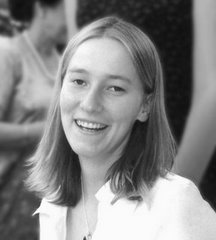
In Memoriam Rachel Corrie 1979 - 2003


19 March 2003
Press Release from the Parents of Rachel CorrieOur daughter Rachel, a volunteer with the International Solidarity Movement in the Occupied Territories, died Sunday in the Gaza Strip while courageously trying to prevent the demolition of a Palestinian home. Our loss is immense, but we are buoyed by the outpouring of support and love that we’ve received from around the world. We understand that Rachel is being remembered in many places in many beautiful ways, and we are grateful. We are comforted and heartened by the compassionate expressions of love that we have received from both Palestinian and Israeli people. We will forever remember and be thankful for Rachel’s ISM and Palestinian friends who cared for her and who held her for us as she died.We are speaking out today because of Rachel’s fears about the impact of a war with Iraq on the people in the Occupied Territories. She reported to us that her Palestinian friends were afraid that with all eyes on Iraq, the Israeli Defense Forces would escalate activity in the Occupied Territories. Rachel wanted to be in Gaza if that happened.In the last six weeks, Rachel became our eyes and ears for Rafah, a city at the southern tip of Gaza. Now that she’s no longer there, we are asking members of Congress and, truly, all the world to watch and listen.One week ago I came rather timidly to members of Rachel’s delegation in Congress, expressing my concerns for the safety of those in the International Solidarity Movement. A piece of me wonders if I had spoken louder or sooner, if this week’s tragedy might have been averted. So today I am speaking up in memory of my daughter and on behalf of all her friends in Gaza.We are greatly concerned for the non-violent internationals volunteering in the Occupied Territories. We ask that members of Congress call upon the Israeli government to cease harassment of these individuals and, specifically, to cease firing upon them when they are engaged in protecting the Palestinian water supply, protecting Palestinian homes from illegal demolitions, and retrieving bodies of murdered Palestinians for return to their families – all events Rachel witnessed.In my last phone conversation with Rachel, she expressed that when we fail to support and protect the Internationals who resist non–violently, we also undercut the non-violent initiatives of the Palestinians. We are, therefore, asking our members of Congress to demand that the American Embassy in Tel Aviv, when called upon for assistance, provide all reasonable support to non-violent, American volunteers in the Occupied Territories, as well as support to other internationals as appropriate.We are asking members of Congress to bring the U.S. government’s attention back to the Israeli-Palestinian crisis and to recognize that the occupation of the Palestinian territories is an overwhelming and continuous act of collective violence against the Palestinian people. We ask that military aid to Israel be commensurate with its efforts to end its occupation of the Palestinian Territories and to adhere to the rules of international law.Rachel would not want her death to overshadow that of others. In barely glancing at headlines since word came of Rachel’s death, I note that many have died this week in the Occupied Territories – one a four-year-old child. I would like to be able to hold the mother of that child and to have her hold me.Yesterday, I looked at a publication entitled "Who Will Save the Children?" with photos of children who have died since September 2000 in Israel and in the Occupied Territories. I understand that the next publication will be dedicated to Rachel and will include her photograph. I want the mothers of these children to know that I have looked at the beaming faces of each of their babies and that I know how much the world has lost with the passing of each one of them.In one of her e-mails Rachel wrote, "Today as I walked on top of the rubble where homes once stood, Egyptian soldiers called to me from the other side of the border, ‘Go! Go!’ because a tank was coming. Followed by waving and "what’s your name?" There is something disturbing about this friendly curiosity. It reminded me of how much, to some degree, we are all kids curious about other kids: Egyptian kids shouting at strange women wandering into the path of tanks. Palestinian kids shot from the tanks when they peek out from behind walls to see what’s going on. International kids standing in front of tanks with banners. Israeli kids in the tanks anonymously, occasionally shouting - and also occasionally waving – many forced to be here, many just aggressive, shooting into the houses as we wander away." How I wish that the young man in the bulldozer that killed Rachel could have just stopped, hopped out, and talked to her. He would have met a beautiful soul.In another e-mail, Rachel wrote, "This has to stop. I think it is a good idea for us all to drop everything and devote our lives to making this stop. I don’t think it’s an extremist thing to do anymore. I really want to dance around to Pat Benatar and have boyfriends and make comics for my co-workers. But I also want this to stop. Disbelief and horror is what I feel. Disappointment. I am disappointed that this is the base reality of our world and that we, in fact, participate in it. This is not at all what I asked for when I came into this world. This is not at all what the people here asked for when they came into this world. This is not what they are asking for now. This is not the world you and Dad wanted me to come into when you decided to have me."Rachel’s brutal death illustrates dramatically the madness of war.

Craig and Cindy Corrie

Ethiopian troops in Somalia ambush

Abdullahi Yusuf Ahmed, the Somali president, hopes to bring stability to his country [AFP]
Posted By Aljazeera.net


A convoy of Ethiopian troops has been ambushed in Mogadishu, the Somali capital, just hours after government troops repelled an attack on the president's palace.

At least one bystander was killed in the fighting that erupted after unknown men attacked the military convoy with machineguns and rocket-propelled grenades on Saturday morning.
bodyVariable350="Htmlphcontrol1_lblError";
The Ethiopian troops responded to the ambush by returning fire with heavy weapons. Some accounts said that as many as four people were killed in the ensuing firefight.

The government played down the attack, dismissing speculation that it was part of a broader anti-government offensive.
bodyVariable300="Htmlphcontrol2_lblError";
"Neither government forces nor our Ethiopian friends suffered any casualties in the attack, which was carried out by simple gunmen to show the international community that Mogadishu is still very unsafe," Abdirahman Dinari, a government spokesman, said.
Several people were also wounded in the brief exchange of fire.

"The Ethiopians shot me," Ali Kheyre Mumin, one of the wounded, said. "They shot at me and the others indiscriminately ... they shot everybody who was moving around."

A senior leader of the Union of Islamic Courts, which controlled Mogadishu and much of southern Somalia until December, took credit for the attack.

"This is a new uprising by the Somali people," Ahmed Qare, deputy chairman of the movement, told the Associated Press.

"The only solution can be reconciliation and talks between the transitional federal government and the Islamic courts."

The attack is the latest of several targeting Ethiopian troops who helped Somali's weak government drive fighters from the Union of Islamic Courts out of the Somali capital last month.

Presidential compound attacked

Late on Friday, attackers fired three mortars into the presidential compound and then engaged guards in a 30-minute fire fight, residents living nearby said.

Ethiopian and government troops riding tanks and heavily armed trucks rolled out of the compound and immediately sealed off the area

There were no reports of casualties.
The president and prime minister were in Mogadishu, but their exact whereabouts were unclear.

Dinari, the government spokesman, said one shell hit the presidential palace, known as Villa Somalia, but that no one inside was injured or killed.

"Those who ambushed the presidential palace escaped, and this is a cowardly act intended to terrorize the public," Dinari said.

The attacks have increased pressure on the Ethiopian troops to withdraw from Somalia.

The African Union has it wants to send troops to replace the Ethiopians but it has yet to prove that it has the troops, money or logistical capability to keep the peace in Somalia.

Somalia has lacked a functioning central government since the authoritarian government of Muhammad Siad Barre was toppled in 1991.

Thursday, January 18, 2007

How racism has invaded Canada

By Robert Fisk - 10 June 2006

http://news.independent.co.uk/world/fisk/article754394.ece
http://www.informationclearinghouse.info/article13575.htm
This has been a good week to be in Canada — or an awful week, depending on your point of view - to understand just how irretrievably biased and potentially racist the Canadian press has become. For, after the arrest of 17 Canadian Muslims on “terrorism” charges, the Toronto Globe and Mail and, to a slightly lesser extent, the National Post, have indulged in an orgy of finger-pointing that must reduce the chances of any fair trial and, at the same time, sow fear in the hearts of the country’s more than 700,000 Muslims. In fact, if I were a Canadian Muslim right now, I’d already be checking the airline timetables for a flight out of town. Or is that the purpose of this press campaign?
First, the charges. Even a lawyer for one of the accused has talked of a plot to storm the Parliament in Ottawa, hold MPs hostage and chop off the head of Prime Minister Stephen Harper. Without challenging the “facts” or casting any doubt on their sources — primarily the Royal Canadian Mounted Police or Canada’s leak-dripping Canadian Security Intelligence Service (CSIS) — reporters have told their readers that the 17 were variously planning to blow up Parliament, CSIS’s headquarters, the Canadian Broadcasting Corporation and sundry other targets. Every veiled and chadored Muslim woman relative of the accused has been photographed and their pictures printed, often on front pages. “Home-grown terrorists” has become theme of the month — even though the “terrorists” have yet to stand trial.
They were in receipt of “fertilizers”, we were told, which could be turned into explosives. When it emerged that Canadian police officers had already switched the “fertilizers” for a less harmful substance, nobody followed up the implications of this apparent “sting”. A Buffalo radio station down in the US even announced that the accused had actually received “explosives”. Bingo: Guilty before trial.
Of course, the Muslim-bashers have laced this nonsense with the usual pious concern for the rights of the accused. “Before I go on, one disclaimer,” purred the Globe and Mail’s Margaret Wente. “Nothing has been proved and nobody should rush to judgment.” Which, needless to say, Wente then went on to do in the same paragraph. “The exposure of our very own home-grown terrorists, if that’s what the men aspired to be, was both predictably shocking and shockingly predictable.” And just in case we missed the point of this hypocrisy, Wente ended her column by announcing that “Canada is not exempt from home-grown terrorism”. Angry young men are the tinderbox and Islamism is the match.
The country will probably have better luck than most at “putting out the fire”, she adds. But who, I wonder, is really lighting the match? For a very unpleasant — albeit initially innocuous — phrase has now found its way into the papers. The accused 17 — and, indeed their families and sometimes the country’s entire Muslim community — are now referred to as “Canadian-born”. Well, yes, they are Canadian-born. But there’s a subtle difference between this and being described as a “Canadian” — as other citizens of this vast country are in every other context. And the implications are obvious; there are now two types of Canadian citizen: The Canadian-born variety (Muslims) and Canadians (the rest).
If this seems finicky, try the following sentence from the Globe and Mail’s front page on Tuesday, supposedly an eyewitness account of the police arrest operation: “Parked directly outside his ... office was a large, gray, cube-shaped truck and, on the ground nearby, he recognized one of the two brown-skinned young men who had taken possession of the next door rented unit...” Come again? Brown-skinned? What in God’s name is this outrageous piece of racism doing on the front page of a major Canadian daily? What is “brown-skinned” supposed to mean — if it is not just a revolting attempt to isolate Muslims as the “other” in Canada’s highly multicultural society? I notice, for example, that when the paper obsequiously refers to Toronto’s police chief and his reportedly brilliant cops, he is not referred to as “white-skinned” (which he most assuredly is). Amid this swamp, Canada’s journalists are managing to soften the realities of their country’s new military involvement in Afghanistan.
More than 2,000 troops are deployed around Kandahar in active military operations against Taleban insurgents. They are taking the place of US troops, who will be transferred to fight even more Muslims insurgents in Iraq.
Canada is thus now involved in the Afghan war — those who doubt this should note the country has already shelled out $1.8bn in “defense spending” in Afghanistan and only $500m in “additional expenditures”, including humanitarian assistance and democratic renewal (sic) — and, by extension, in Iraq. In other words, Canada has gone to war in the Middle East.
None of this, according to the Canadian foreign minister, could be the cause of Muslim anger at home, although Jack Hooper — the CSIS chief who has a lot to learn about the Middle East but talks far too much — said a few days ago that “we had a high threat profile (in Canada) before Afghanistan. In any event, the presence of Canadians and Canadian forces there has elevated that threat somewhat.” I read all this on a flight from Calgary to Ottawa this week, sitting just a row behind Tim Goddard, his wife Sally and daughter Victoria, who were chatting gently and smiling bravely to the crew and fellow passengers. In the cargo hold of our aircraft lay the coffin of Goddard’s other daughter, Nichola, the first Canadian woman soldier to be killed in action in Afghanistan.
The next day, he scattered sand on Nichola’s coffin at Canada’s national military cemetery. A heartrending photograph of him appeared in the Post — but buried away on Page 6. And on the front page? A picture of British policemen standing outside the Bradford home of a Muslim “who may have links to Canada”. Allegedly, of course.

Emergency landing for Minister

Norway's Foreign Minister Jonas Gahr Støre was aboard a plane forced to land in Kandahar in southern Afghanistan on Wednesday
Støre and bodyguards, co-workers and a group of Norwegian press were supposed to return to capital Kabul after a visit to Tirin Kot in the south of the country in an Australian transport plane. Only upon landing did the passengers learn that they were in Kandahar, reputed to be the most dangerous city in the country.
"I thought we had landed in Kabul," said a surprised Støre after emerging onto the landing strip in the darkness. From there he was taken to a provisional terminal building.
Problems with air pressure aboard the plane forced the landing, as the plane was unable to rise above the mountains surrounding the Afghan capital.
As night began to fall there was doubt that either the plane or a replacement would be ready in time to transport the group to Kabul on Wednesday. Støre, who is on a three-day visit to Afghanistan, was preparing for a night in Kandahar under uncertain conditions.
Kandahar has been the scene of recent fighting between NATO soldiers and Taliban insurgents.
Posted by aftenposten
(Aftenposten English Web Desk/NTB)

Sunday, January 14, 2007

Saddam's half brother hanged

By jumana.heresh@aljazeera.net


Saddam Hussein's half brother and the former head of Iraq's revolutionary court are reported to have been hanged.
Barzan Ibrahim, Saddam's half brother and former intelligence chief, and Awad Hamed al-Bandar, the ex-head of Iraq's Revolutionary Court, had been found guilty along with Saddam in the killing of 148 Shiite Muslims.
bodyVariable350="Htmlphcontrol1_lblError";
Munqith al-Faroon, an Iraqi prosecutor, confirmed the deaths to the Associated Press news agency only two weeks and two days after Saddam was executed in chaotic scenes that drew worldwide criticism.

Jalal Talabani, the Iraqi president, last week urged the government to delay the executions.

Saturday, January 13, 2007

Ahmadinejad on Latin America tour

Ahmadinejad is locked in a tense standoff with the US over uranium enrichment and influence in Iraq [AFP]
Posted By Aljazeera.net

The Iranian president has left on a Latin American tour of Venezuela, Ecuador, Bolivia and Nicaragua, countries whose governments are critical of Washington.

bodyVariable350="Htmlphcontrol1_lblError";
Mahmoud Ahmadinejad will hold talks with his ideological "brother" Hugo Chavez, the Venezuelan president, on the start of his tour.

In Caracas, the two leaders were expected to sign a series of new trade and economic co-operation agreements.
bodyVariable300="Htmlphcontrol2_lblError";
"Iran and Venezuela are two important allies on a global level, the two countries have important industrial and oil projects which we will follow up in this trip," Ahmadinejad said before flying from Tehran.

Ahmadinejad has praised Chavez for his outspoken support of Iran's nuclear program, which the US and European governments say is part of a project to build atomic weapons.

Facing sanctions imposed by the UN Security Council over its uranium enrichment work and the threat of international isolation, Iran is keen to demonstrate it has backing among a number of leaders in Latin America.

Venezuelan support

Chavez is the most vocal supporter in Latin America for Iran and its president, with both men calling each other "brother" and relishing their status as fierce opponents of Washington's influence.
"Hugo is my brother," Ahmadinejad said during his last visit to Venezuela in September, when the two leaders inaugurated a joint oil well. "Hugo is the champion of the fight against imperialism."

In September 2005, Venezuela was alone in opposing a resolution at the International Atomic Energy Agency (IAEA) that found Iran in violation of nuclear safeguards. Since then, Chavez has completely backed Iran's right to enrich uranium.

Iran and Venezuela are both important players in the Organisation of Petroleum Exporting Countries (Opec) and have signed numerous co-operation agreements in the energy sector and other fields.

During a visit to Iran last September, Chavez came out in support of Iran's nuclear program, as well as denouncing Israeli military operations in Lebanon.

The two presidents also signed deals covering iron and steel production, petrochemicals, pharmaceuticals and health care equipment, and munitions.

While Ahmadinejad seeks to cultivate Latin American allies, Condoleezza Rice, the US secretary of state, has headed to the Middle East to rally Arab support for a new US strategy in Iraq and to counter Iran's alleged interference in Iraq.

Before her departure, Rice warned that the United States would not be passive in the face of what she called Iran's "regional aggression".

"I think you will see that the United States is not going to simply stand idly by and let these activities continue," she said.

Ecuador ceremony

After his one-day visit to Caracas, Ahmadinejad plans to head to Managua to hold talks with Daniel Ortega, Nicaragua's president and a US Cold War foe.

On Monday, Ahmadinejad will take part in the swearing-in ceremony of Ecuador's new president Rafael Correa, who has vowed to forge stronger ties with Venezuela and not to renew a lease for a US military air base on the country's Pacific coast.
The Iranian president will also hold meetings with other South American presidents including Bolivia's Evo Morales on the sidelines of the ceremony in Ecuador, before finishing his tour on Tuesday.

Thursday, January 11, 2007

Bangladesh president quits interim government, delays election

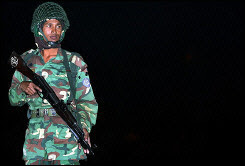
A Bangladeshi military soldier secures his position near the presidential palace in Dhaka. Bangladesh's president buckled to massive opposition and international pressure by quitting his role as head of an interim government and promising "free and fair" elections for the country.
Bangladesh's president buckled to massive opposition and international pressure by quitting his role as head of an interim government and agreeing to postpone disputed national elections.
.
President Iajuddin Ahmed's announcement came hours after he declared a state of emergency in a bid to tackle worsening violence generated by opposition allegations that the polls, scheduled for January 22, would be rigged.
.
New elections at a later date, the president promised in his dramatic U-turn, would be "free and fair".
.
"I have decided to resign as head of the caretaker government, to pave the way for an acceptable election in which all political parties can participate," the president said in a televised speech to the nation.
.
"The new caretaker government will hold dialogue with all the parties, and prepare for new elections within the shortest possible time," he said.
.
His temporary replacement as head of the interim government, responsible for organising the vote, is Supreme Court judge Fazlul Haq -- widely seen as being politically independent.
.
Ahmed will continue to serve as figurehead president.
.
The opposition, led by the left-leaning Awami League, said the announcement was a "victory for the people".
.
They had alleged the planned election would be biased in favour of the outgoing Bangladesh Nationalist Party (BNP), and have demanded a complete overhaul of an electoral list said to contain 14 million ghost voters.
.
"By admitting that the voter list had errors, and quitting as head of the interim government, he has in fact accepted our main demands," opposition spokesman Abdul Jalil told AFP.
.
The opposition had also promised a boycott and a series of non-stop protests, blockades and strikes, meaning the politically-polarised nation was facing -- as the president put it -- a "grave situation".
.
Ahmed said the pre-poll unrest and the loss of dozens of lives, meant it had become a "necessity to declare an emergency", involving a ban on all political activities and a curfew from 11:00 pm to 5:00 am.
.
"It is the expectation of the people to have a free and fair elections... that are acceptable to all parties, at home and abroad," the embattled president said, just a day after he had called 60,000 troops out on the streets.
.
Analysts said the state of emergency and announcement was likely to restore immediate calm to the country, as weeks of protests give way to intense negotiations between the rival parties.
.
Ahmed's decision came after the United Nations said it had suspended "all technical support to the electoral process" and warned it was concerned for the future of the country's democracy.
.
The European Union said it had suspended its election observation mission to Bangladesh, one of the poorest, most corrupt and densely-populated nations on earth.
.
Britain, the former colonial power, also condemned plans to hold elections regardless of the opposition boycott.
.
And crucially, the UN threatened to strip the Bangladeshi army of its prestigious and lucrative international 'blue helmet' peacekeeping duties if it backed elections with no opposition participation.
.
UN peacekeeping missions and the income they generate are highly prized in the Bangladeshi armed forces, and such a warning would have subjected the president to serious pressure to delay the polls, analysts said.
.
The Muslim-dominated but secular country of 144 million, formerly known as East Pakistan, has a history of instability, coups and counter coups since winning independence from Pakistan in 1971.
.
Although democracy was restored in 1991, the Awami League and the BNP have each regularly boycotted parliament and staged national strikes as a negotiating tactic when in opposition.
.
The crisis has also badly damaged the country's economy, with exports including from the crucial textile sector held up at Chittagong, home to the country's largest port. — AFP
Bangladesh's president buckled to massive opposition and international pressure by quitting his role as head of an interim government and agreeing to postpone disputed national elections.
.
President Iajuddin Ahmed's announcement came hours after he declared a state of emergency in a bid to tackle worsening violence generated by opposition allegations that the polls, scheduled for January 22, would be rigged.
.
New elections at a later date, the president promised in his dramatic U-turn, would be "free and fair".
.
"I have decided to resign as head of the caretaker government, to pave the way for an acceptable election in which all political parties can participate," the president said in a televised speech to the nation.
.
"The new caretaker government will hold dialogue with all the parties, and prepare for new elections within the shortest possible time," he said.
.
His temporary replacement as head of the interim government, responsible for organising the vote, is Supreme Court judge Fazlul Haq -- widely seen as being politically independent.
.
Ahmed will continue to serve as figurehead president.
.
The opposition, led by the left-leaning Awami League, said the announcement was a "victory for the people".
.
They had alleged the planned election would be biased in favour of the outgoing Bangladesh Nationalist Party (BNP), and have demanded a complete overhaul of an electoral list said to contain 14 million ghost voters.
.
"By admitting that the voter list had errors, and quitting as head of the interim government, he has in fact accepted our main demands," opposition spokesman Abdul Jalil told AFP.
.
The opposition had also promised a boycott and a series of non-stop protests, blockades and strikes, meaning the politically-polarised nation was facing -- as the president put it -- a "grave situation".
.
Ahmed said the pre-poll unrest and the loss of dozens of lives, meant it had become a "necessity to declare an emergency", involving a ban on all political activities and a curfew from 11:00 pm to 5:00 am.
.
"It is the expectation of the people to have a free and fair elections... that are acceptable to all parties, at home and abroad," the embattled president said, just a day after he had called 60,000 troops out on the streets.
.
Analysts said the state of emergency and announcement was likely to restore immediate calm to the country, as weeks of protests give way to intense negotiations between the rival parties.
.
Ahmed's decision came after the United Nations said it had suspended "all technical support to the electoral process" and warned it was concerned for the future of the country's democracy.
.
The European Union said it had suspended its election observation mission to Bangladesh, one of the poorest, most corrupt and densely-populated nations on earth.
.
Britain, the former colonial power, also condemned plans to hold elections regardless of the opposition boycott.
.
And crucially, the UN threatened to strip the Bangladeshi army of its prestigious and lucrative international 'blue helmet' peacekeeping duties if it backed elections with no opposition participation.
.
UN peacekeeping missions and the income they generate are highly prized in the Bangladeshi armed forces, and such a warning would have subjected the president to serious pressure to delay the polls, analysts said.
.
The Muslim-dominated but secular country of 144 million, formerly known as East Pakistan, has a history of instability, coups and counter coups since winning independence from Pakistan in 1971.
.
Although democracy was restored in 1991, the Awami League and the BNP have each regularly boycotted parliament and staged national strikes as a negotiating tactic when in opposition.
.
The crisis has also badly damaged the country's economy, with exports including from the crucial textile sector held up at Chittagong, home to the country's largest port. — AFP

Monday, January 08, 2007

Les Don Quichotte lèvent les camps... doucement - The Gift Quichotte raise the camps gently…

REUTERS
L'association a déclaré lundi la fin des campements en France, après l'annonce par le gouvernement de la création de 27000 nouvelles places d'hébergement d'urgence. Cependant, de nombreux SDF refusent de partir tant que des solutions ne sont pas concrètement appliquées.
Association declared Monday the end of the campings in France, after the advertisement by the government of the creation of 27000 new places of emergency lodging. However, of many SDF refuse to leave as long as solutions are not concretely applied.


«On lève les camps.» C'est par ces mots que le porte-parole des Enfants de Don Quichotte, Augustin Legrand, a annoncé lundi à Paris que l'association entamait «immédiatement un processus qui mettra fin à tous les campements» de sans-abri qu'elle a installés à travers la France. L'annonce a été faite devant un parterre de journalistes venant de tous les pays qui ont attendu la «star», comme le surnomme certains SDF, pendant plus d'une demi-heure. Juché sur un escalier au bord du canal, Legrand, qui lisait un texte, a ajouté dans son mégaphone : «Un changement radical de politique concernant les sans-abri et la certitude qu'un droit au logement opposable sera adopté prochainement dans un vrai esprit de consensus politique et associatif, nous conduisent à une sortie de crise immédiate.» «Un plan d'urgence est mis en œuvre dès aujourd'hui et nous démarrons immédiatement le processus qui nous conduira à la fin de tous les campements», a-t-il ajouté au bord du canal Saint-Martin où l'association a installé un campement de tentes depuis le 16 décembre, mettant le problème du logement au centre de l'actualité. Il a également ajouté que «la charte des Enfants de Don Quichotte avait été acceptée dans tous ses principes». Visiblement excédé par près d'un mois de lutte, le porte-parole n'a pas souhaité commenter le communiqué distribué aux journalistes. Il a tenu à préciser qu'il «partait dans l'heure» et qu'il n'avait «pas le temps de répondre aux quarante questions des journalistes». Direction l'Afrique du Sud et un tournage d'une durée de trois semaines. Les SDF ne sont pas prêts à lever le camp pour autant. Jean-Baptiste Legrand, le frère d'Augustin a précisé qu'ils allaient «plier les tentes au fur et à mesure que les SDF vont retrouver un logement», en précisant que cela pourrait prendre «plusieurs semaines» avant que le campement de quelque 250 tentes soit levé. Les sans-abri présents sont d'ailleurs sceptiques devant les promesses du gouvernement. Christian, un SDF présent sur le campement parisien, s'emporte. Pour lui, «tout ça c'est des promesses, c'est bidon». Et lui, comme tant d'autres, ne bougera pas tant que il n'y aura rien de concret. A Lille, les Don Quichotte annoncent qu'ils souhaitent rester 48 heures devant le parvis de l'église Saint-Maurice, «le temps que chacun trouve une solution de logement». A Nice aussi, les Don Quichotte refusent de partir. Les quelque 30 tentes installées sur la plage centrale ne seront pas démontées avant que «tout le monde soit relogé», a indiqué Robert Bourgeois, un porte-parole local de l'organisation. Reclamant de la considération, les Don Quichotte niçois veulent être consultés avant toute signature d'accord au niveau national. Peu avant cette annonce, le ministre de la Cohésion sociale, Jean-Louis Borloo, et le ministre délégué à la Cohésion sociale, Catherine Vautrin, que les Enfants de Don Quichotte avaient rencontrés ce week-end, avaient annoncé un «plan d'action renforcé» pour 2007 afin d'héberger de façon «pérenne» et «adaptée» toute personne accueillie en urgence, qui «s'appuiera sur 27.100 places nouvelles». Ils ont également confirmé que le gouvernement présentera un projet de loi instituant un droit au logement opposable.
.......In English.......
“One raises the camps.” It is by these words that the spokesman of the Children of Gift Quichotte, Augustin Legrand, announced Monday in Paris that association immediately started “a process which will put an end to all the campings” of homeless person that it installed through France. The advertisement was made in front of a floor of journalists coming from all the countries which awaited the “star”, as certain SDF call it, during more than one half an hour. Perched on a staircase at the edge of the channel, Legrand, which read a text, added in its loud-hailer: “A radical change of policy concerning the homeless people and the certainty which a right to opposable housing will be adopted soon in a true spirit of political and associative consensus, lead us to an exit of immediate crisis.” “An emergency plan is implemented as of today and we immediately start the process which will lead us at the end of all the campings”, it added at the edge of the Saint Martin's day channel where association installed a camping of tents since December 16, putting the housing problem at the center of the topicality. It also added that “the charter of the Children of Gift Quichotte had been accepted in all its principles”. Obviously exceeded by nearly one month of fight, the spokesman did not wish to comment on the official statement distributed to the journalists. He made a point of specifying that he “left in the hour” and that he did not have “not time to answer the forty questions of the journalists”. Direction South Africa and turning a one three weeks duration. The SDF are not ready to raise the camp for as much. Jean-baptiste Legrand, the brother of Augustin specified that they were going “to fold the tents as the SDF will find a housing”, by specifying that that could take “several weeks” before the camping of some 250 tents is raised. The homeless people present are skeptics besides in front of the promises of the government. Christian, a SDF present on the Parisian camping, carries himself. For him, “all that they is promises, it is can”. And him, like so much of others, will not move as much as there will be nothing concrete. In Lille, the Gift Quichotte announce that they wish to remain 48 hours in front of the square of the Saint-Maurice church, “time that each one find a solution of housing”. In Nice also, the Gift Quichotte refuse to leave. The few 30 tents installed on the central beach will not be dismounted before “everyone is rehoused”, indicated Robert Bourgeois, a local spokesman of the organization. Claiming consideration, the Gift Quichotte niçois want to be consulted before any signature of agreement at the national level. Little before this advertisement, the Minister for social Cohesion, Jean-Louis Borloo, and the minister delegated to social Cohesion, Catherine Vautrin, that the Children of Gift Quichotte had met this weekend, had announced a “action plan reinforced” for 2007 in order to lodge in perennial” and “adapted” way a “any person accomodated in urgency, which “will be based on 27.100 new places”. They also confirmed that the government will present a bill instituting a right to opposable housing.

Sunday, December 31, 2006

Video shows Saddam being taunted

The grainy image of Saddam's execution was probably captured on a mobile phone by a witness

A new video has emerged showing Saddam Hussein, the former Iraqi president, exchanging taunts with onlookers before the gallows floor dropped away and he was hanged.
bodyVariable350="Htmlphcontrol1_lblError";
The video, first broadcast by Al Jazeera on Sunday, was captured on a mobile phone when Saddam was executed on Saturday.

Someone among the witnesses can be heard praising Muhammad Bakr al-Sadr, the founder of the Shia Dawa party and an uncle of Muqtada al-Sadr, who was executed in 1980 by Saddam.
bodyVariable300="Htmlphcontrol2_lblError";
"God damn you," a guard said.

"God damn you," replied Saddam.

Saddam appeared to smile at those taunting him from below the gallows. He said they were not showing manhood.

Then Saddam began reciting the Shahada, a Muslim prayer that says there is no God but God and Muhammad is his messenger, according to an unabridged copy of the video clip, which was posted on a website.

Saddam made it to midway through his second recitation of the verse. His last word was Muhammad. Then the floor dropped out of the gallows.

'Act of revenge'

Najib al-Nuaimi, a member of the defence team, told Al Jazeera on Sunday that no Sunni lawyer was allowed to be among the execution witnesses and that the conduct of those present showed it was an act of revenge and for political purposes.

"This is not in the normal procedures to execute a normal person," he said.

"It's full of hatred and it's very ugly. It's nothing to do with the Dujail case."
By several accounts, Saddam was calm but scornful of his captors, engaging in a give-and-take with the crowd gathered to watch him die and insisting he was Iraq's saviour, not its tyrant and scourge.

Munir Haddad, an appeals court judge who witnessed the hanging, told the BBC: "He said we are going to heaven and our enemies will rot in hell and he also called for forgiveness and love among Iraqis but also stressed that the Iraqis should fight the Americans and the Persians."

Witness account

Another witness, Mowaffak al-Rubaie, the Iraqi national security adviser, told The New York Times that one of the guards shouted at Saddam: "You have destroyed us. You have killed us. You have made us live in destitution."

Al-Rubaie told the newspaper that Saddam responded: "I have saved you from destitution and misery and destroyed your enemies, the Persians and Americans."

Saddam has been buried in Awja village, close to Tikrit.

Ali al-Nida, head of the Albu Nasir tribe, said that the burial had taken place at 4am in a family plot in the village of Saddam's birth.

It is Muslim practice to bury the dead within a day. Saddam's sons, Uday and Qusay, are buried in Awja.

Al Jazeera's correspondent Hoda Abd al-Hamid said he was buried in a remote corner, his grave covered with the Iraqi flag.

Saddam's family had hoped to bury him in Ramadi, a symbolic site, but they were prevented from doing so due to security reasons.

Peace prospects

There is little prospect of peace from al-Qaeda in Iraq, but Nuri al-Maliki, the Iraqi prime minister, and George Bush, the US president, hope that more moderate Sunnis may now choose negotiation over violence.

Unusually, the government did not even see a need for a curfew in Baghdad.
Protests in Saddam's home town and in the mainly Sunni west were small.

Although resentful at a loss of influence, few Sunnis found much to mourn in Saddam's passing.

Many Kurds were disappointed that Saddam was not convicted of genocide against them in a trial yet to finish.

With violence killing hundreds every week, Iraqis have other worries. Celebrations in Shia cities and the Sadr City slum in Baghdad were brief and fairly restrained.

Execution condemned

The UN, the Vatican and Washington's European allies all condemned the execution on moral grounds.
Many Muslims, especially Sunnis, making the Hajj pilgrimage to Mecca were outraged by the symbolism of hanging Saddam on the holiest day of the year at the start of Eid al-Adha - some Shia also said his death was a suitable gift from God.
After complaints of interference by Shia politicians in the trial, the speed of the execution may add to unease about the fairness of the US-sponsored process.

Barzan al-Tikriti, Saddam's half-brother, and Awad al-Bander, a former judge, will be hanged for the same crimes in January.

Sectarian violence
Al-Maliki, his fragile authority among fellow Shia significantly enhanced after he forced through Saddam's execution over Sunni and Kurdish hesitation, has reached out to Saddam's Sunni supporters

"Saddam's execution puts an end to all the pathetic gambles on a return to dictatorship," he said in a statement as state television showed him signing the death warrant in red ink.

"I urge ... followers of the ousted regime to reconsider their stance as the door is still open to anyone who has no innocent blood on his hands to help in rebuilding ... Iraq."


Source: Agencies By Aljazeera.net

Wednesday, December 27, 2006

亞洲電訊因台灣地震受到嚴重干擾 Telecom Asia were seriously affected by the earthquake in Taiwan


Earthquake shook the entire island of Taiwan
周二台灣附近發生強烈地震使海地電纜受到破壞,亞洲各地的電訊受到嚴重影響。
Tuesday cable near Taiwan, where a strong earthquake in Haiti has been destroyed in Asia's telecommunications have been seriously affected.
據報道,台灣、韓國、中國和日本的銀行和商務都受到電話和互聯網問題的困擾。
據美國地理調查透露,在台灣南部海域發生了強度為里氏7.1級的地震。
地震震撼了整個台灣島,2人在地震中喪生,至少42人受傷。
地震中心位于台灣南部恆春外海,地震后發生強烈余震,在屏東等南部縣造成了災情。
海嘯警報中心警告周邊100公里地區防范出現局部海嘯。
台灣最大的電話公司中華電信表示,海地電纜受到破壞,使台灣同馬來西亞、新加坡、泰國和香港的通訊98%受到了影響。
該公司的負責人說,修復工作需要3周時間,但是通訊質量將會逐日得到改善。
在香港、日本和中國的電訊公司也受到了影響。BBC中文部在香港的辦公室的互聯網連接也被中斷。
中國最大的電訊公司中國電訊集團表示,通往美國和歐洲的電纜受到了破壞。
韓國寬帶服務公司KT公司表示,6條海地電纜受到影響,中斷了對客戶的服務,包括對銀行提供的服務。
據報道一些外匯交易也受到影響。
許多公司受到警告說,今后几天的互聯網連接將被減慢。
這次地震正值亞洲海嘯發生兩周年,那次海嘯中將近25萬人喪生。
According to reports, Taiwan, South Korea, China and Japan's banking and business telephone and the Internet have been plagued by problems. According to the United States Geological Survey revealed that the intensity of the waters in southern Taiwan, an earthquake with a magnitude of 7.1. Earthquake shook the entire island of Taiwan, two people were killed in the earthquake, at least 42 people were injured. Quake off Hengchun in southern Taiwan, where a strong earthquake aftershocks in Pingtung County caused such a disaster. 100-kilometer area surrounding the Pacific Tsunami Warning Center warned against any local tsunami. Taiwan's largest telephone company Chunghwa Telecom said that the damage to cables in Haiti, Taiwan, Malaysia, Singapore, Thailand and Hong Kong 98% of communication were affected. The company officials said that repair work may take three weeks, but will gradually improve the quality of communications. In Hong Kong, Japanese and Chinese telecommunications companies have also been affected. BBC中文部 in office Internet connection has been interrupted. China Telecom Group, China's largest telecommunications company, said access to the United States and Europe, the cables have been damaged. South Korean broadband company KT company said that six of Haiti cables affected, the disruption of service to customers. including the provision of banking services. It has been reported that a number of foreign exchange transactions will be affected. Many companies have been warned that the coming days will be slower Internet connections. The earthquake was the second anniversary of the Asian tsunami, tsunami that killed nearly 250,000 people.

Saturday, December 23, 2006

Weapons of Mass Destruction (WMD) 大规模毁灭性武器(大规模毁灭性武器)


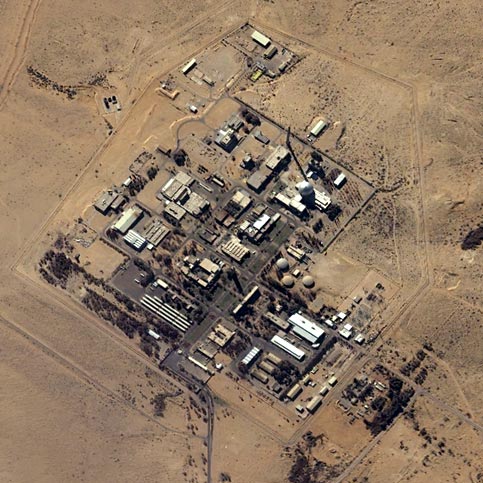
迪莫纳反应堆,从太空. (图片:太空影像/太空旅游特克)

The Dimona Reactor, as seen from space. (Photo: Space Imaging/NTA Space Turk)

Nuclear Weapons --- 核武器

The Israeli nuclear weapons program grew out of the conviction that the Holocaust justified any measures Israel took to ensure its survival. Consequently, Israel has been actively investigating the nuclear option from its earliest days. In 1949, HEMED GIMMEL a special unit of the IDF's Science Corps, began a two-year geological survey of the Negev desert with an eye toward the discovery of uranium reserves. Although no significant sources of uranium were found, recoverable amounts were located in phosphate deposits.
The program took another step forward with the creation of the Israel Atomic Energy Commission (IAEC) in 1952. Its chairman, Ernst David Bergmann, had long advocated an Israeli bomb as the best way to ensure "that we shall never again be led as lambs to the slaughter." Bergmann was also head of the Ministry of Defense's Research and Infrastructure Division (known by its Hebrew acronym, EMET), which had taken over the HEMED research centers (HEMED GIMMEL among them, now renamed Machon 4) as part of a reorganization. Under Bergmann, the line between the IAEC and EMET blurred to the point that Machon 4 functioned essentially as the chief laboratory for the IAEC. By 1953, Machon 4 had not only perfected a process for extracting the uranium found in the Negev, but had also developed a new method of producing heavy water, providing Israel with an indigenous capability to produce some of the most important nuclear materials.
For reactor design and construction, Israel sought the assistance of France. Nuclear cooperation between the two nations dates back as far as early 1950's, when construction began on France's 40MWt heavy water reactor and a chemical reprocessing plant at Marcoule. France was a natural partner for Israel and both governments saw an independent nuclear option as a means by which they could maintain a degree of autonomy in the bipolar environment of the cold war.
In the fall of 1956, France agreed to provide Israel with an 18 MWt research reactor. However, the onset of the Suez Crisis a few weeks later changed the situation dramatically. Following Egypt's closure of the Suez Canal in July, France and Britain had agreed with Israel that the latter should provoke a war with Egypt to provide the European nations with the pretext to send in their troops as peacekeepers to occupy and reopen the canal zone. In the wake of the Suez Crisis, the Soviet Union made a thinly veiled threat against the three nations. This episode not only enhanced the Israeli view that an independent nuclear capability was needed to prevent reliance on potentially unreliable allies, but also led to a sense of debt among French leaders that they had failed to fulfill commitments made to a partner. French premier Guy Mollet is even quoted as saying privately that France "owed" the bomb to Israel.
On 3 October 1957, France and Israel signed a revised agreement calling for France to build a 24 MWt reactor (although the cooling systems and waste facilities were designed to handle three times that power) and, in protocols that were not committed to paper, a chemical reprocessing plant. This complex was constructed in secret, and outside the IAEA inspection regime, by French and Israeli technicians at Dimona, in the Negev desert under the leadership of Col. Manes Pratt of the IDF Ordinance Corps.
Both the scale of the project and the secrecy involved made the construction of Dimona a massive undertaking. A new intelligence agency, the Office of Science Liasons, (LEKEM) was created to provide security and intelligence for the project. At the height construction, some 1,500 Israelis some French workers were employed building Dimona. To maintain secrecy, French customs officials were told that the largest of the reactor components, such as the reactor tank, were part of a desalinization plant bound for Latin America. In addition, after buying heavy water from Norway on the condition that it not be transferred to a third country, the French Air Force secretly flew as much as four tons of the substance to Israel.
Trouble arose in May 1960, when France began to pressure Israel to make the project public and to submit to international inspections of the site, threatening to withhold the reactor fuel unless they did. President de Gaulle was concerned that the inevitable scandal following any revelations about French assistance with the project, especially the chemical reprocessing plant, would have negative repercussions for France's international position, already on shaky ground because of its war in Algeria.
At a subsequent meeting with Ben-Gurion, de Gaulle offered to sell Israel fighter aircraft in exchange for stopping work on the reprocessing plant, and came away from the meeting convinced that the matter was closed. It was not. Over the next few months, Israel worked out a compromise. France would supply the uranium and components already placed on order and would not insist on international inspections. In return, Israel would assure France that they had no intention of making atomic weapons, would not reprocess any plutonium, and would reveal the existence of the reactor, which would be completed without French assistance. In reality, not much changed - French contractors finished work on the reactor and reprocessing plant, uranium fuel was delivered and the reactor went critical in 1964.
In a report published on 4 August 2005, the BBC revealed evidence from the British National Archives that showed that the UK sold 20 tons of heavy water to Israel for £1.5 million in 1958. The heavy water, surplus from a shipment purchased by the UK from Norway in 1956, was for use in Israel's Dimona reactor. British officials involved in the deal made a conscious effort to keep the deal secret from both the United States and ministers of their own government. In 1961, Israel asked the UK for more heavy water, but due to the publicity that the Dimona project was receiving at the time, the British declined to sell any more to the Israelis.
The United States first became aware of Dimona's existence after U-2 overflights in 1958 captured the facility's construction, but it was not identified as a nuclear site until two years later. The complex was variously explained as a textile plant, an agricultural station, and a metallurgical research facility, until David Ben-Gurion stated in December 1960 that Dimona complex was a nuclear research center built for "peaceful purposes."
There followed two decades in which the United States, through a combination of benign neglect, erroneous analysis, and successful Israeli deception, failed to discern first the details of Israel's nuclear program. As early as 8 December 1960, the CIA issued a report outlining Dimona's implications for nuclear proliferation, and the CIA station in Tel Aviv had determined by the mid-1960s that the Israeli nuclear weapons program was an established and irreversible fact.
United States inspectors visited Dimona seven times during the 1960s, but they were unable to obtain an accurate picture of the activities carried out there, largely due to tight Israeli control over the timing and agenda of the visits. The Israelis went so far as to install false control room panels and to brick over elevators and hallways that accessed certain areas of the facility. The inspectors were able to report that there was no clear scientific research or civilian nuclear power program justifying such a large reactor - circumstantial evidence of the Israeli bomb program - but found no evidence of "weapons related activities" such as the existence of a plutonium reprocessing plant.
Although the United States government did not encourage or approve of the Israeli nuclear program, it also did nothing to stop it. Walworth Barbour, US ambassador to Israel from 1961-73, the bomb program's crucial years, primarily saw his job as being to insulate the President from facts which might compel him to act on the nuclear issue, alledgedly saying at one point that "The President did not send me there to give him problems. He does not want to be told any bad news." After the 1967 war, Barbour even put a stop to military attachés' intelligence collection efforts around Dimona. Even when Barbour did authorize forwarding information, as he did in 1966 when embassy staff learned that Israel was beginning to put nuclear warheads in missiles, the message seemed to disappear into the bureaucracy and was never acted upon.
In early 1968, the CIA issued a report concluding that Israel had successfully started production of nuclear weapons. This estimate, however, was based on an informal conversation between Carl Duckett, head of the CIA's Office of Science and Technology, and Edward Teller, father of the hydrogen bomb. Teller said that, based on conversations with friends in the Israeli scientific and defense establishment, he had concluded that Israel was capable of building the bomb, and that the CIA should not wait for an Israeli test to make a final assessment because that test would never be carried out.

Posted By www.globalsecurity.org

Read it in Chinese --> 阅读中文

以色列核武计划核武器的前身有理由确信屠杀以色列采取任何措施,以确保其生存. 因此,以色列一直在积极调查其核选择从最早天. 1949年,哈迈德gimmel国防军特种部队的科学兵团 开始两年内盖夫沙漠地质调查与主导权发现铀储量. 虽然没有发现重大的铀源,可采量位于磷酸盐存款. 节目又迈进了一大步,创造了以色列原子能委员会于1952年(原子能). 主席恩斯特幼斯蒂娜 曾长期主张以色列炸弹是最佳的保证",决不再为主导羊羔" 斯蒂娜也是国防部主管科研和基础设施司(希伯来已知其缩写,emet) 已接管哈迈德研究中心(哈迈德gimmel当中 现在改machon4)作为重组. 根据斯蒂娜 emet间的界线模糊,并给伊拉克原子能machon四点基本上为行政运作的原子能实验室. 由1953年4machon不仅完善了工艺提取铀格夫发现, 还研制生产重水的新方法, 向以色列提供原生产能力的一些最重要的核原料. 为反应堆设计和施工,以色列寻求协助法国. 两国核合作据追溯到50年代初, 当法国开始建造的重水反应堆和40mwt化学厂在Marcoule的. 法国是天然的伙伴,两国政府认为,以色列的核选择作为一个独立的方法,使他们能够保持一定程度的自治两极冷战环境. 1956年秋,法国同意向以色列提供18兆瓦研究堆. 然而,苏伊士运河危机爆发几周之后形势急剧变化. 继埃及的苏伊士运河关闭7 法国和英国已同意与以色列挑起战争,后者应提供与埃及同欧洲国家在其部队为借口派遣维和重新占领运河区. 在苏伊士运河危机之后,苏联作了掩饰霸道威胁三国. 这个插曲不仅加强以色列认为独立核能力需要依赖可能是不可靠的盟国,以防止、 而且导致了法国领导人之间的债务意识,他们没有履行自己承诺的一个伙伴. 法国总理家伙mollet甚至话说私下表示,法国"欠"的炸弹给以色列. 关于1957年10月3日, 法国和以色列签署了一项协议,要求法国修改建设24兆瓦反应堆(虽然冷却系统和废物处理设施的设计能力三倍), 在协议中未承诺皮化学厂. 这是在复杂的秘密,国际原子能机构检查制度以外,法国和以色列在迪莫纳技术员、 在盖夫沙漠鬃毛普拉特领导下的国防军上校军团条例. 无论规模和项目建设取得涉及保密迪莫纳浩大. 新情报机构,办事处科学liasons(lekem)创立提供安全和情报的项目. 在施工高峰,约1500名以色列人一些法国建筑工人迪莫纳. 为了保密,法国海关官员表示,最大的反应堆组件 例如反应堆坦克,是一部海水淡化厂运往拉丁美洲. 此外, 在买重水从挪威的情况下,它不会被转移到第三国, 法国空军秘密出动高达4吨的物质到以色列. 1960年5月发生故障, 当法国开始向以色列施加压力,使公共工程和向国际视察现场 扬言中止反应堆的燃料,除非他们这样做的. 戴高乐总统担心难免有爆发的丑闻之后,法国与援助项目 尤其化学厂,将有负面影响,法国的国际地位, 因为它已经动摇地面战争在阿尔及利亚. 在随后与本-古里、 戴高乐售予以色列战斗机对换工作停厂, 来到远离会议确信此事被关闭. 它不是. 在未来几个月,以色列出台了妥协. 法国将与零件供应的铀已经放在秩序和不坚持国际核查. 作为回报,以色列会向法国表示他们无意制造原子武器 没有任何加工钚,并揭示存在反应堆 将未经竣工法国援助. 实际上,没有多少改变法国反应堆工程承包商和成品厂、 铀作燃料的反应堆是在1964年进入关键. 在2005年8月4日发表的一份报告, 证据显示,英国广播公司从英国国家档案显示,卖出20吨重水给以色列为150万英镑1958. 大量用水,剩余由一批从英国购买了挪威在1956年 被用于以色列迪莫纳反应堆. 英国官员参与了这项交易的自觉努力,保持双方的秘密协议,美国和其政府的部长. 1961年,英国要求以色列更多重水, 但由于宣传的迪莫纳项目接收当时 英国拒绝出售更多的以色列人. 美国首次发现迪莫纳生存后的U-2飞越1958被俘设施的建设、 但不列为核现场,直到两年后. 被解释为各种复杂的纺织工厂,一个农业站、冶金研究设施、 直到幼本-古里表示,在1960年12月,是一个复杂的迪莫纳核研究中心的建成,为"和平目的" 随后的二十年中,美国通过多种良性忽视,分析错误, 以色列成功行骗,没有看出第一细节以色列的核计划. 早在1960年12月8日,美国中央情报局发表一份报告,概述迪莫纳的影响核扩散 和中央情报局曾在特拉维夫站由60年代中期,以色列核武计划是既定的和不可逆转的事实. 美国核查人员参观迪莫纳七次六十年 但是他们无法准确了解目前所开展的活动, 由于以色列严格控制访问的时间和议程. 以色列人竟以虚假控制室安装板和砖瓦对电梯或走廊,进入某些领域居. 核查人员可以向各位报告,也没有明确的科学研究或民用核能计画说明这样的大型反应堆旁证了以色列炸弹节目,但发现没有证据表明"武器有关的活动",如存在着钚的工厂. 尽管美国政府不鼓励或批准了以色列的核计划 它也没有什么可以阻止它. walworth钝,从1961年至1973年美国驻以色列的炸弹计划的关键年 主要看他的工作是为了保障总统从事实可能逼其法在核问题上 一度alledgedly说,"总统没有给他送我上的问题. 他不想告诉任何坏消息. " 1967年战争后,连江雪制止武官的情报收集工作迪莫纳左右. 即使没有授权江雪传递信息、 他曾在1966年时为大使馆工作人员介绍,以色列开始把核弹头飞弹 这个信息似乎并没有消失在官僚行事. 1968年初,美国中央情报局发表报告总结说,以色列已成功启动生产核武器. 这项估计,不过,根据一项非正式对话卡尔包皮、 美国中央情报局长办公室科技、承天出纳员、氢弹之父. 柜员说,基于朋友的交谈中,以色列科学和国防建设, 他得出结论说,以色列的轰炸能力建设, 中央情报局和以色列不要等待检验,进行最后评估,因为这不会进行测试.

Monday, December 11, 2006

Press reflects split over Pinochet

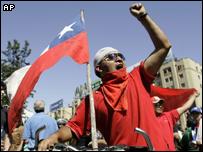
Supporters and opponents of Gen Pinochet took to the streets

Strong passions sparked off by the death of the former Chilean military ruler Augusto Pinochet are evident in the pages of the Chilean press.
Comments range from satisfaction to sadness, with some pointing to the fact that Pinochet died on human rights day.
La Tercera publishes scathing remarks by the president of the Families of The Detained and Disappeared Group, Lorena Pizarro.
"Do you know how people feel today in this country? That the worst scum that this fatherland has given birth to has died", she is quoted as saying.
Ms Pizarro says it is symbolic that Pinochet died on human rights day.

"How wise is history, Pinochet died on 10 December, so perhaps the whole of humanity said enough is enough", she says.
The coincidence was also highlighted by the popular paper La Cuarta, with its headline "Pinochet died on human rights day".
It reports that his death coincided with the 84th birthday of his wife.
'Fervour'
La Cuarta also reports on the polarized reactions to the announcement of the death.
It notes both "the fervour of his supporters who yelled for flags to be flown at half mast" and "the hundreds of families waving flags celebrating his death in the area of La Victoria".
For La Hora, "there is no middle ground with Pinochet - you either love him or hate him".
"The light and dark of an historic day," runs a headline in the paper. "No sooner had the death of Augusto Pinochet been announced than his supporters and opponents took to the streets to give vent to their emotions".

An editorial in La Tercera says the death marks "the disappearance of the principle figure in Chilean politics for at least the past three decades".
"But he and his regime are, lamentably, destined to continue causing controversy for a long time to come."
A letter in the paper says: "We Christian Democrats who defend the dignity of the human being find it unacceptable to celebrate the death of a person, whatever their crimes."
'Figure from the past'
And a political commentator in the same paper argues that "most people saw Pinochet as a figure from the past".
"I hope these people, both supporters and adversaries, can start looking towards the future rather than back to the past."
A headline in the major conservative daily El Mercurio proclaims "Profound impact in Chile and the world: Pinochet dies."
An El Mercurio editorial speaks of the "deep hatred which divided Chilean society" and argues that Pinochet acted to "bring an end to the gravest crisis in Chile in the last century, an insoluble crisis".
It says the debate over Pinochet's heritage will continue for many years but makes a plea for "reconciliation" between "all who fought from different perspectives to forge a better Chile".
BBC Monitoring selects and translates news from radio, television, press, news agencies and the internet from 150 countries in more than 70 languages. It is based in Caversham, UK, and has several bureaux abroad.
Posted By www.BBC.co.uk

Thursday, December 07, 2006

News from Canada - Harper mum as Commons debates same-sex marriage proposal

Janice Tibbetts, CanWest News Service
Published: Thursday, December 07, 2006
OTTAWA - Prime Minister Stephen Harper, the man who promised to bring the contentious same-sex marriage issue back to the Commons, was absent from the chamber and had no plans to defend traditional marriage as debate opened Wednesday on whether to revoke Canada's same-sex marriage law.
The Commons was virtually empty, with about 20 of 308 members showing up, including Conservative House leader Rob Nicholson.
He acknowledged at the onset that ''some members may question why it's necessary to engage this House on this matter.''
Nicholson introduced a motion ''to call on government to introduce legislation to restore the traditional definition of marriage without affecting civil unions and while respecting existing same-sex marriages.''
As he led the government's case, Nicholson spent little time arguing why the gay-marriage law should be revoked, focusing instead on the fact that the government made an election promise to revive the issue.
''Given the importance of marriage in our society and its importance to Canadians, we made a commitment in the last election to ask parliamentarians whether they wished to revisit this issue,'' Nicholson said.
MPs were to debate the issue until late Wednesday night, with a vote scheduled for today.
The motion is expected to fail, with the minority Conservatives finding little support on the opposition benches.
At least a dozen Conservatives are also expected to vote against the government, including cabinet ministers John Baird, Jim Prentice, Loyola Hearn and David Emerson.
On the Liberal benches, it is anticipated that only handful of MPs will vote to reopen the gay marriage issue.
Liberal Leader Stephane Dion, calling the prospect ''an attack against the charter,'' had pondered imposing a whipped vote, meaning that Liberal MPs would have had to vote against the government or face discipline.
But after adding up the numbers and concluding there is virtually no chance the vote will succeed, Dion said Wednesday that Liberals will be able to vote as they wish so that Harper cannot accuse him of gagging his MPs.
''A free vote will prove that the overwhelming majority are not willing to go with the government on this issue and then that will be the end of the story,'' Dion said.
The NDP and the Bloc Quebecois are imposing party discipline and voting en masse against the motion.
Harper promised gay-marriage opponents on the first day of last winter's election campaign to hold a Commons vote on whether to re-open debate on Canada's 2005 law, a move that critics say mobilized his socially conservative supporters.
Liberal MP Bill Graham, leading the Liberal assault on the motion, dismissed it as a stunt that carries no weight and said that if the government was serious ''they would have introduced legislation.''
Graham said the only way for the government to restore the traditional definition is to use the Constitution's ''notwithstanding clause,'' which allows governments to override court decisions for up to five years.
The previous Liberal government, reacting to a string of court rulings, passed a law in June 2005 that rewrote the traditional definition of marriage. The vote in the Commons succeeded 158-133.

Monday, December 04, 2006

China should increase gold holdings


China's foreign exchange reserves have become a thorny issue for the government. Experts around the world have suggested ways in which China might address the surplus of foreign exchange reserves. However, many of these simply involve consuming the excess which could easily lead to inflation. Any attempt to address the excess of foreign exchange reserves should incorporate a fundamental economic restructuring and an adjustment of the RMB exchange rate formation mechanism, which will be a long and slow process. In the process the government can pursue some complementary policies to reduce its huge foreign currency reserves. The author believes that raising gold holdings should be one of government's strategic choices.
Gold has played a very important role in the international monetary system. With the Demonetization of Gold, decided at a meeting in Jamaica in 1976 after the breakdown of the Bretton Woods system, the function of gold as a currency has been weakened and its status in the international reserve system fallen. As a result, many countries and regions reduced their gold holdings. However, following the Asian financial crisis, the US' economic downturn and the depreciation of the dollar, gold once again has risen in importance. Many countries have restored or even raised their gold holdings and adjusted the proportion of gold in their reserves, seeking a better role for gold in the modern economy.
Gold has several functions. It can be a tool in a diversified investment portfolio and can spread investment risks. Gold has high liquidity, high security and low profitability. With a high liquidity, it can realize any market price freely. This is compatible with the ability of reserve assets to deal with any unexpected economic difficulties. Despite low profitability gold can have a very important hedging function. It can be combined with some asset portfolios that are high risk but also high benefit, increasing investment benefits at the same level as risks.
Gold is also important in helping prevent inflation. For emerging countries and markets, low interest rates, high oil prices and rampant fund speculation has increased the extent of inflation. To curb the bubble economy that could arise from inflation, countries usually adopt macroeconomic controls such as increasing the interest rate. Gold is another effective means of preventing inflation. History shows that gold prices increase in sync with the rise of the inflation index and often in a higher range. During deflation, the price of gold does not necessarily fall in line with the index, or by a lower margin.
In addition, holders of gold are able to meet their temporary funding needs in emergencies. During its 1998 financial crisis in 1998, Russia sold off 33 percent of its gold reserves. In 2001, to deal with a series of natural disasters that had befallen the country, it sold more of its gold holdings and invested the money into the reconstruction of Siberia. During the Asian Financial Crisis, Malaysia, South Korea and Thailand all appealed to residents to convert their gold into local government bonds or to turn the gold they had collected directly into holdings or into dollars either to pay for the debt or to reduce risks. This helped stabilize the local currencies.
Gold assets have unique features. Gold holdings is an issue that concerns national sovereignty. Every country has autonomous control of its gold. Gold does not involve a liability, nor is it subject to any country's economic policies, including the direct impact of monetary and fiscal policies.
China's Central Bank says that China has 600 tons of gold holdings, equal to about 19.29 million ounces. This figure has not changed since December 2002. China's gold reserves account for only 1.3 percent of its total foreign exchange reserves, far lower than the 3 percent that is standard in other countries. With the rapid growth of foreign exchange reserves, which now exceed US$1 trillion, the ratio of gold in China's foreign exchange reserves is even lower. In the long term, China should raise its gold holdings. The price of gold has rebounded since April 2001 and a record high was set in May 2006 ¨C US$725 per ounce. Currently an ounce of gold sells for approximately US$625. The price of gold has fluctuated but overall it remains high. If China adopts a long-term strategic approach, accurately predict the market price of gold and purchase gold in a timely and reasonable manner, it can preserve and increase the value of gold, improve the reserve structure, and create a solid foundation for the internationalization of the RMB in the future.
By People's Daily Online; The author, Gao Jie, is an Associate Professor at the School of Finance in the University of International Business and Economics

Thursday, November 30, 2006

China, DPRK, U.S. agree to resume six-party talks


Top negotiators of China, the Democratic People's Republic of Korea (DPRK) and the United States agreed to resume the six-party talks on the Korean Peninsula nuclear issue as soon as possible, Chinese Foreign Ministry said on Wednesday.
The negotiators held several rounds of bilateral and trilateral talks in Beijing from Tuesday to Wednesday, exchanging views "frankly and in an in-depth way", said the Ministry.
The negotiations have "increased mutual understanding" between the three parties, who agreed to work together for the early resumption and progress of the six-party talks, the Ministry said.
But it did not say whether an exact date has been set.
The top negotiators of China, the DPRK, the United States, the Republic of Korea (ROK) and Japan are all in Beijing making preparations for the resumption of the talks.
On Tuesday's regular press conference of the Ministry, spokeswoman Jiang Yu said the exact date for the resumption of the talks was still undecided.
Jiang called on all parties to take a "flexible and pragmatic approach" and work toward the early resumption of the talks and make concerted efforts to achieve progress.
The six-party talks, aimed at finding a solution to the Korean Peninsula nuclear issue, have been stalled since last November as the DPRK refused to return to the talks because of U.S. sanctions against it.
Source: Xinhua

China reaffirms efforts to push for Mideast peace


Chinese Premier Wen Jiabao has reiterated his country's readiness to join international efforts to push for peace and stability in the Middle East region.
In a message to the Conference in Commemoration of the International Day of Solidarity with the Palestinian People held at the UN headquarters in New York on Wednesday, Wen extended warm congratulations on the occasion of its convocation on behalf of the Chinese government.
In the message, Wen stressed the Palestinian issue is at the core of the Middle East conflict. "China supports restart of the Middle East peace process and resumption of political negotiations as soon as possible, so as to establish an independent state of Palestine that co-exists peacefully with Israel, on the basis of relevant UN resolutions and the 'land for peace' principle," he said.
The settlement of the Palestinian issue calls for political will and courage of the Palestinians and Israel as well, and needs support and assistance from the international community, Wen said.
As a permanent member of the UN Security Council, China would continue its support for a larger UN role in the Middle East issue, he said.
"China is ready to make unswerving efforts with the international community for a fair and overall solution to the Palestinian issue and an early realization of peace and stability in the Middle East region," the Chinese premier said.
The United Nations set Nov. 29 as the Day of Solidarity with the Palestinian People.
Source: Xinhua

Wednesday, November 08, 2006

Israelis believe in the killing of children and women

Palestinian children

I don't have to say anything, the picture speaks for it self, everyone knows that the Israelis believe in the killing of kids and women.


Look at the picture, I ask you WHY? because they are Arab children, then we should call them European children, Perhaps we might get the world attention.

Tony

Thursday, November 02, 2006

Israeli killings resume in Gaza Strip

The killings took place in the northern town of Beit Hanoun

Israeli troops are reported to have killed four Palestinians in northern Gaza, two of them civilians including a 75-year-old, in one of its biggest operations in the coastal strip in months.
Witnesses said soldiers, backed by tanks and using loudspeakers, ordered all residents over 16 years of age in the town of Beit Hanoun to present themselves at a school for questioning.

The town of 30,000 people has been effectively under an army curfew since the Israeli troops entered it on Wednesday, the witnesses said.

The latest casualties bring to 13 the number of Palestinians killed since Wednesday.

Although the Israeli army says the operation was aimed partly at halting rocket fire at the Jewish state from northern Gaza, militants launched four homemade missiles at the nearby Israeli border town of Sderot, wounding one person, medical officials said.

Peace talks

"Residents are in panic as the sound of gunfire and explosions never stops. The curfew is very, very tight" Yamen Hamad, a local journalist
Thursday's offensive has further weakened the prospects of resuming peace talks between the two sides, already minimal since the Hamas movement took office in March after winning elections.

Hamas has said the bloodshed could also complicate Egyptian-brokered talks aimed at arranging a swap of Palestinian prisoners in Israel for an Israeli soldier abducted by militants in a cross-border raid last June.

"Residents are in panic as the sound of gunfire and explosions never stops. The curfew is very, very tight," Yamen Hamad, a local journalist, told Reuters by telephone.

One Israeli soldier was killed during the raid. More than half the Palestinians who died were said to be militants.

An Israeli army spokeswoman said all men in Beit Hanoun had been asked to gather in one place to answer questions.

Children wounded

Relatives said one of the civilians killed on Thursday, a 75-year-old man, was shot by troops on a rooftop when he went onto the balcony of his home to take his disabled son inside. The army said its forces were only targeting militants.

Among the dead was a Hamas gunman who worked as a bodyguard for Ismail Haniyeh, the Palestinian prime minister, witnesses said.

Hospital officials said 15 people had been wounded, including four children and a woman injured when a tank shell hit their house.

The assault is one of the biggest since Israel launched an offensive in Gaza to try to force the release of the captured soldier and halt the rocket fire.

More than 280 Palestinians have been killed in the four-month-old offensive, about half of them civilians. Three Israeli soldiers have been killed.

Monday, October 30, 2006

Chavez denies being anti-US

Chavez says he wants to strengthen ties with Arab nations

Hugo Rafael Chavez Frías, the 53rd president of Venezuela, was born on July 28 1954. He came to power in 1998, promising to help Venezuela's poor majority, and was re-elected in 2000. He survived a coup in 2002 and faces a presidential election in December.
Since becoming president he has followed a policy of democratic socialism, Latin American integration and anti-imperialism.

His reforms have created much controversy in Venezuela and abroad. Most Venezuelans are split between those who say he has empowered the poor and stimulated economic growth, and those who say he is autocratic and has badly managed the economy.

Some foreign governments view Chavez as a threat to world oil prices and regional stability, while others welcome his bilateral trade and reciprocal aid agreements.

Chavez recently described George Bush, the US president, as "the devil" and says Bush has plans to assassinate him and invade Venezuela. He recently talked to Aljazeera about his relationship with the US, the Venezuelan army and why he gets only a few hours' sleep a night.

Aljazeera.net: You are strengthening ties with countries that are dissatisfied with Washington, countries such as Iran, Bolivia and Cuba. What is the end game of such an alliance?

Hugo Chavez: We are not against the US people, where there are children, women, intellectuals and students. We have investments in the US, we have eight refineries there, we have 14,000 gas stations. I have many friends there, I have played baseball there, I even have a nephew there.

What we are against is the imperial elite and that is very different. This is not a game. Do you think Iraq is a game, the aggression against Latin America for a century is a game, the toppling of Allende, the invasions of Grenada, Haiti, Panama, Jamaica, the Dominican Republic, Guatemala, is that a game?

If that's a game, then my goodness that would be awful. This is an aggression and every day more and more people are against this hegemony and trying to save the world. Look at Lebanon, the aggression against the Palestinian people, why do they do that? Because the Israelis are supported by the elite of the US. We are against that.

Some would say in order for such an alliance to stop these events and counter the power of Washington that you refer to, regional powers such as China and Russia would need to back it. You hold talks with the leaders of these countries, are they ready to come on board for such an alliance?

You insist on something that is out of my main focus. I have never said we want to build an alliance against the US, so your question is not really focused.

If you take Moscow, Iran, Vietnam, China, Malaysia, what we are doing is getting closer through integration, through energy, oil, gas, trade and respect for international law.

We are today on a campaign around the world asking for support for Venezuela to become part of the Security Council as a non–permanent member. The US is in a terrible campaign to prevent us being elected. We are defending our interests but we are not proposing an alliance against anyone, much less the people of the United States. So your question is out of focus.

In May 2005, you called for an alliance between Latin America and the Arab world. How far has that initiative gone?

Not only me, Lula [Brazil's president] has been outspoken in calling for the coming together of Latin America and the Arab countries.

In Brasilia in May we had the first ever Arab-South American summit. It was a very important meeting.

In the past, only Venezuela had strong relations with the Arab world through Opec and through links with other non-Opec countries such as Egypt.

But now Lula is convening these meetings, he is coming to the Arab world. Not long ago in Venezuela we held a meeting between senior ministers in charge of education and social matters in both Latin America and the Arab world. We have made serious progress. It is not just an individual proposal of Hugo Chavez, it is a proposal of leaders like Muammar al-Qadhafi and the amir of Qatar. As well as Lula and Eva Morales [Bolivia's president]. And we want to get our two regions together.

You have started an ambitious programme to rebuild your military, you are buying new weapons, you are trying to raise, I think, the largest standing army in the Americas. If everything goes to plan, you will have two million reserve troops. What has prompted this military build up?

Let me tell you something. I hardly have time to sleep a few hours a day, but I don't care because I've decided to devote my life to taking my people out of poverty and misery.

To make a great effort for all Venezuelans to have access to education, health, housing, to life. When we were elected, poverty in Venezuela was over 55 per cent based on UN figures, it is now between 30 per cent and 40 per cent.

We are building a system of Bolivarian schools where children can have breakfast, lunch and dinner, gain internet access and take part in sports activities.

I devote a tiny part of my time to being commander-in-chief of the Venezuelan army. The imperialists have threatened to invade Venezuela, they have already conducted a coup d'etat four years ago. Recently they conducted manoeuvres in the Caribbean. We have even captured US soldiers taking pictures of military installations and we have expelled them.

We have much evidence, proof and documents that show there is a plan to invade Venezuela. What do you want us to do? That I forget my task of minimum defence of the country?

We had old rifles, they were 60-years old. We depended almost totally on US supplies. The F16 fighters we bought 20 years ago, they refused to give us spare parts, and they were stranded on the ground. So I have bought better planes and Kalashnikovs from Moscow. We have a vast border with Colombia, we have a huge coastal line along the Caribbean. We have to defend this country. We are not going to be aggressors.

Do you feel you are still being targeted and threatened by the US? We know that some people in the US have spoken in the past about assassinating you. Do you still feel personally targeted by the US?

Yes indeed. People have publicly called for my assassination and that is a crime. However, this person is not in jail, he is a close friend of the US president.

Venezuelan terrorists who left for the US after the 2002 coup, who killed people in Venezuela, are today living in the US. The US will not extradite them. Some of them are organising actions against myself and Venezuela.

The US is protecting terrorism. They are applying state terror. President Bush has left a measure taken by a former president that authorises the CIA, like 007, with a permit to kill whoever, whenever and however. They have a green light. President Carter banned that practice and the current president has just reinstated it. I am one of the targets, no doubt about it.

If the opposition parties do take part in the forthcoming Venezuelan presidential elections will you make a move towards presidency for life?

There is no way I can adopt such a provision. We have a constitution and it is only the people who might change the constitution in this direction or any other direction. They have the power to hold a referendum to remove the power given to me. The people can collect and gather signatures to ask for a referendum to recall a government official and that is totally democratic
By Aljazeera.net

Thursday, October 19, 2006

Iraq similar to Vietnam says Bush

Pressure is growing on Bush over the worsening situation in Iraq

The US president has for the first time acknowledged a possible parallel between the raging violence in Iraq and the Vietnam War.

George Bush on Wednesday was asked in an ABC News interview if he agreed with a New York Times columnist's comparison of the strife in Iraq with the Tet Offensive, which is considered a key turning point in the US war in Vietnam.
"He could be right," he said. "There's certainly a stepped up level of violence."
Bush said insurgents are trying "to inflict enough damage that we'd leave."
"First of all, al-Qaeda is still very active in Iraq. They are dangerous. They are lethal. They are trying to not only kill American troops, but they're trying to foment sectarian violence," he said.
"They believe that if they can create enough chaos, the American people will grow sick and tired of the Iraqi effort and will cause (the) government to withdraw," Bush said.
Vietnamese campaign
The Tet Offensive, a campaign launched by the North Vietnamese in early 1968, was considered a military defeat for them, but the scope of the assault shocked Americans and helped turn US public opinion against the war.
The White House later sought to put the comparison in context.
"The full context was that the comparison was about the propaganda waged in the Tet Offensive ... and the president was reiterating something he's said before - that the enemy is trying to shake our will," Dana Perino, a Bush spokeswoman, said in a statement.
"The president also believes the American people understand the importance of beating our enemy who is determined to kill innocent freedom-loving people"
Dana Perino, White House spokeswoman
"They know that we're a caring and compassionate people and that we're deeply affected by gross violence," she said.
"The president also believes the American people understand the importance of beating our enemy who is determined to kill innocent freedom-loving people."
In the television interview, the US leader also expressed support for Nuri al-Maliki, the Iraqi prime minister, but warned that his patience is not infinite.
"In my judgment, Maliki has got what it takes to lead a unity government," Bush said.
"I'm patient. I'm not patient forever. And I'm not patient with dawdling. But I recognise the degree of difficulty of the task, and therefore, say to the American people, we won't cut and run," he said.
By www.Aljazeera.net